

Bittensor has built a market for intelligence: Subnets coordinate specialized AI workloads, miners compete on performance, and validators enforce quality.
What has been missing is a capital markets layer designed with the same rigor as the protocol itself.
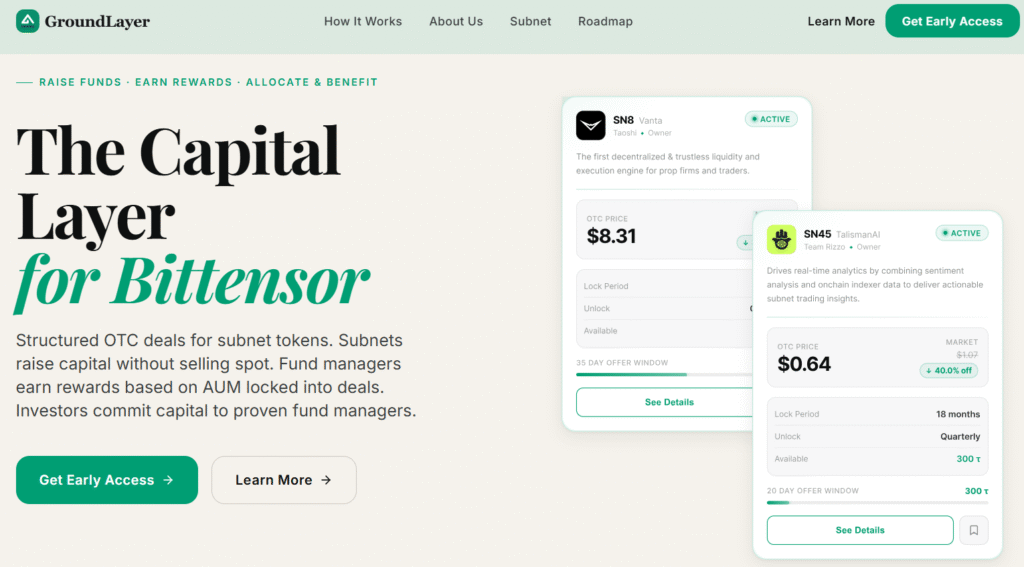
GroundLayer, set to launch on Subnet 20 and built by Taoshi and Team Rizzo AI, introduces structured, on-chain OTC (Over-the-Counter) infrastructure to the Bittensor economy.
Its objective is to enable institutional grade capital formation without destabilizing spot markets, to become a coordination layer for serious capital.
The Structural Gap in the Bittensor Economy
Bittensor’s innovation cycle has accelerated. Subnet proliferation, differentiated tokenomics, and AI specialization have expanded the network’s economic complexity.
However, capital access remains largely informal. Spot markets are volatile, OTC deals are opaque, and allocation mechanisms lack standardized enforcement.
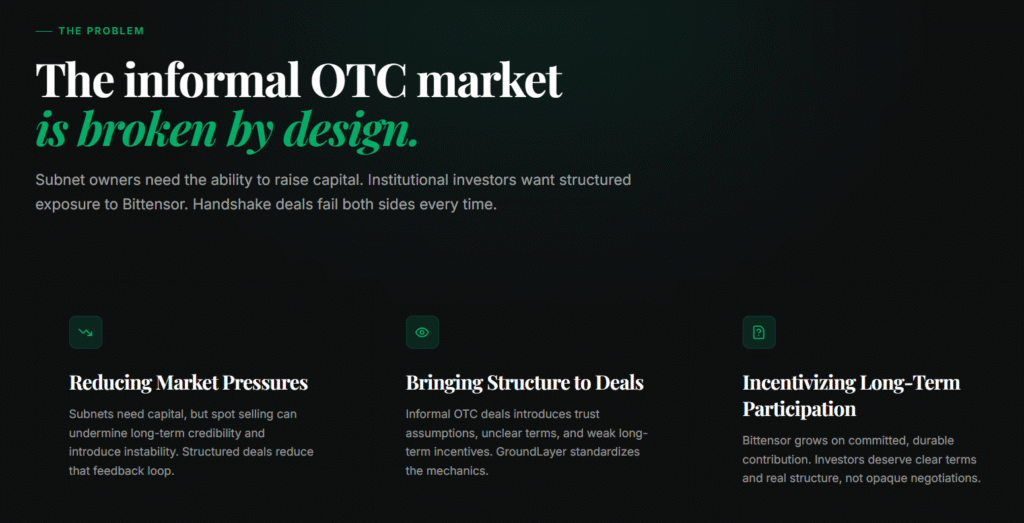
Institutional allocators require:
a. Defined pricing frameworks,
b. Explicit discount structures,
c. Lock schedules and vesting logic,
d. Optionality clauses, and
e. Enforceable execution.
Without these elements, large capital flows either hesitate or extract value inefficiently. GroundLayer is designed to formalize this process.
What GroundLayer Delivers
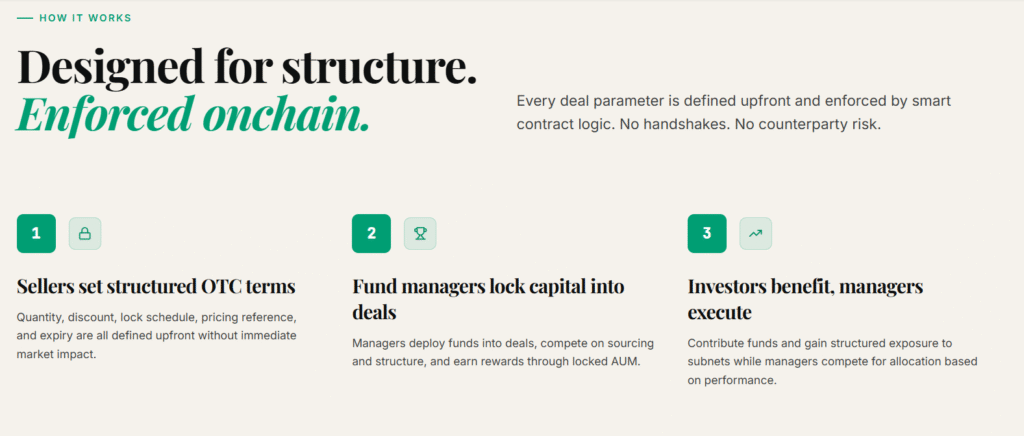
GroundLayer establishes a structured OTC marketplace natively integrated into Subnet 20 where every deal parameter is defined upfront and enforced via smart contract logic.
Core characteristics include:
a. Predefined quantities and pricing references,
b. Clear discount mechanisms,
c. Custom lock schedules,
d. Optionality and expiry conditions,
e. On-chain enforcement, and
f. No immediate impact on token spot price.
This model allows subnet owners to raise capital without triggering reflexive volatility. Simultaneously, investors gain structured exposure that aligns with long-term network participation rather than short-term speculation.
The emphasis is on durability, not velocity.
Subnet 20 as a Capital Coordination Engine
On Subnet 20, fund managers operate as miners, and their objective is not inference performance, but capital deployment discipline.
Managers lock $TAO into structured OTC agreements and earn rewards based on assets under management (AUM). Performance is measurable and competitive.
The architecture functions across three aligned roles:
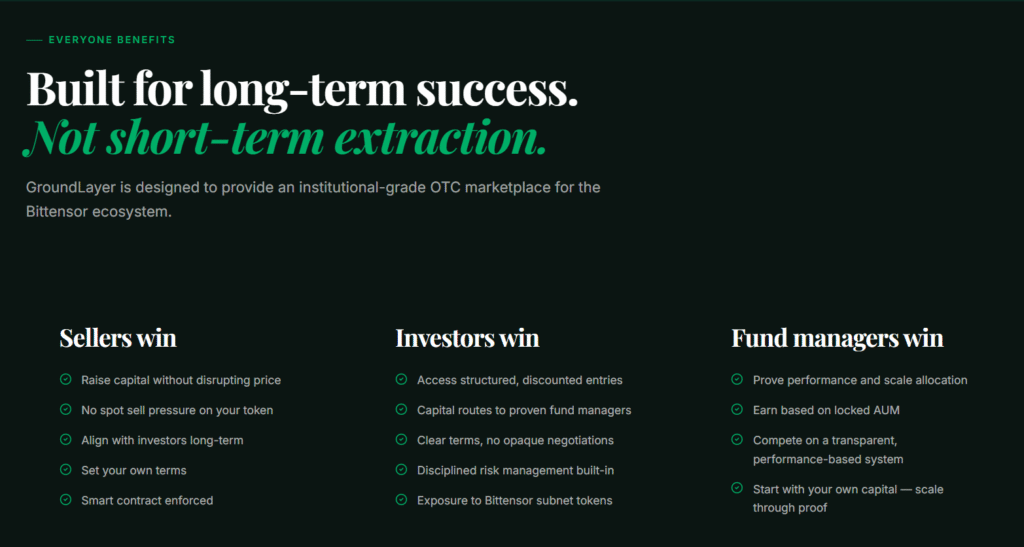
a. Sellers
Subnet owners or token holders define OTC terms in advance, including quantity, discount, lock duration, pricing references, and expiry logic. Capital is raised without destabilizing the secondary market.
b. Fund Managers
Managers allocate capital into structured deals, competing on sourcing quality, allocation efficiency, and performance track record. Rewards scale with locked AUM and execution consistency.
c. Investors
Participants gain structured exposure through predefined economic terms, accessing subnet growth while mitigating market execution risk.
The result is a transparent and programmable capital stack layered directly onto Bittensor’s intelligence economy.
Why This Matters Now
As Bittensor matures, capital efficiency becomes as important as technical performance. Subnets require funding to scale, and investors require structure to deploy meaningfully.
GroundLayer aligns these incentives without compromising price discovery in public markets.
In practical terms, this introduces:
a. Reduced spot market pressure during capital raises,
b. Long-term lock alignment across stakeholders,
c. Transparent, enforceable economic agreements, and
d. Performance-driven capital allocation.
It is a shift from speculative liquidity cycles toward structured capital coordination.
The Institutionalization of Bittensor
GroundLayer represents a broader evolution within Bittensor. The network is transitioning from an experimental AI incentive system into a multi-layer economic ecosystem. Intelligence was the first primitive, capital coordination is the next.
By embedding structured OTC infrastructure directly into Subnet 20, GroundLayer creates the conditions for scalable, institutionally compatible growth.
For serious allocators, this is not about narrative participation. It is about programmable exposure, defined downside structure, and transparent performance incentives.
Bittensor built a market for intelligence, and GroundLayer is building the market structure around it.

Be the first to comment