

Prediction markets have quietly crossed a point of no return. What once looked like a niche gambling interface for crypto users is now being treated as one of the most valuable sources of real-time sentiment in global finance.
The clearest signal arrived when Intercontinental Exchange (ICE), the parent company of the New York Stock Exchange (NYSE), invested $2 Billion into Polymarket and secured exclusive rights to distribute its probability data to institutions.
That single deal reframed the entire industry. Prediction markets are no longer experimental playgrounds. They are now pipelines of alternative data powering hedge funds, banks, and quantitative firms.
Why Prediction Markets Matter
Traditional forecasting is built on punditry. Analysts and commentators make bold claims about elections, interest rate decisions, or geopolitical events without meaningful consequences when they are wrong. The cost of being incorrect is minimal.
Prediction markets change that dynamic. Participants must stake capital, and if their prediction fails, their position goes to zero. This mechanism filters out casual guesses and rewards those who track unfolding events with real skin in the game.
This is why prediction markets routinely react faster to breaking news than major outlets. Traders with real-time information move immediately because money is at stake.
The Liquidity Paradox
However, prediction markets face a fundamental challenge. High-quality forecasting thrives on accuracy, but market infrastructure thrives on liquidity. To operate smoothly, a prediction market needs enough buying and selling activity to keep spreads tight and slippage low.
Polymarket solved liquidity by removing trading fees altogether. The result is impressive volume and a thriving order book. But that volume is not created solely by informed traders. It also includes:
a. Market makers capturing spreads,
b. Arbitrage bots exploiting price gaps, and
c. Momentum bots reacting to micro-patterns
In the raw data, these automated trades appear identical to those placed by traders with genuine insight. Institutions buying this data must filter out the noise before uncovering the true market signal. This friction has opened the door for a new class of infrastructure.
Almanac: Filtering the Signal From the Noise
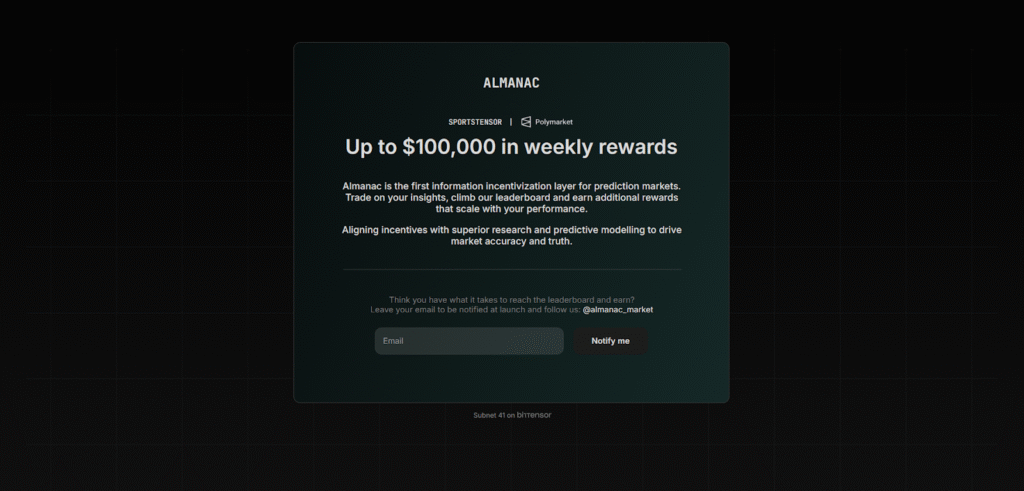
Almanac Market, a product powered by Sportstensor (Subnet 41 on Bittensor), positions itself as a refinement layer on top of Polymarket. It routes trades through Polymarket’s liquidity while applying a simple but powerful filter: a 1% trading fee.
In high-frequency environments, that fee is enormous. It instantly eliminates strategies that rely on tiny margins. Arbitrage bots and wash traders simply cannot operate profitably under a 1% cost structure.
The only participants who remain are high-conviction traders, people who believe their information advantage is strong enough to overcome the fee.
This creates a cleaner dataset. The trades routed through Almanac reflect deliberate, research-backed decisions rather than automated noise.
How the Incentive System Works
Almanac does something unusual. It does not keep the trading fees. Instead, they are redistributed to a reward pool for the top traders on the leaderboard.
This introduces a dual-incentive mechanism:
a. Market Reward (Traders earn money for being right),
b.Performance Reward (They earn additional payouts for outperforming peers).
This structure produces a verifiable record of accuracy across different domains. Over time, Almanac can identify:
a. Who consistently predicts sports outcomes,
b. Who has an edge in macroeconomic events,
c. Who excels in crypto price forecasting, and
d. Who performs best in political prediction markets.
It transforms prediction markets into merit-based discovery engines where the best forecasters rise to the top.
Why the Revolution Starts With Sports
Sports markets are the ideal proving ground for this intelligence layer. They offer:
a. Thousands of settlement events every week,
b. Deep-liquidity and high-trading velocity, and
c. Fast feedback loops for evaluating accuracy.
Compared to elections or central bank meetings, sports generate far more data points, accelerating the refinement of trader rankings and models. Once robust in the sports domain, the intelligence layer can scale to virtually any asset class.
The Arms Race Toward AI-Assisted Forecasting
A predictable second-order effect follows. As rewards grow and leaderboards gain prestige, top traders begin upgrading their toolkits.
Human intuition alone will not be enough. Machine learning, automated data ingestion, and probabilistic modeling will become standard weapons in the competition for accuracy.
Just as quantitative funds reshaped Wall Street, AI-enhanced traders will shape prediction markets. Their improvements lift the accuracy of the entire ecosystem.
The Next Frontier: Intelligent Alternative Data
The ICE investment proves institutions are hungry for this new class of data. But raw volume alone is not enough for sophisticated firms. They need structured, curated intelligence.
This is where the distinction becomes clear:
a. Polymarket provides raw sentiment volume, and
b. Almanac extracts high-conviction intelligence.
The former is a firehose and the latter is a distilled signal. Together, they form the foundation of a market where accuracy is measured, rewarded, and made investable.
Follow the Smart Money
As prediction markets integrate with traditional finance, the winning layer will be the one that identifies who is consistently right. Not what the crowd thinks, but what the smartest people in the crowd are doing.
This is the emerging frontier of alternative data.The $2 Billion investment wasn’t just validation of Polymarket. It was validation of an entire category: the future of intelligence markets where truth is measured in incentives, accuracy is openly ranked, and the best forecasters become the new analysts of the digital age.
Enjoyed this article? Join our newsletter
Get the latest Bittensor & TAO ecosystem news straight to your inbox.
We respect your privacy. Unsubscribe anytime.



Be the first to comment