
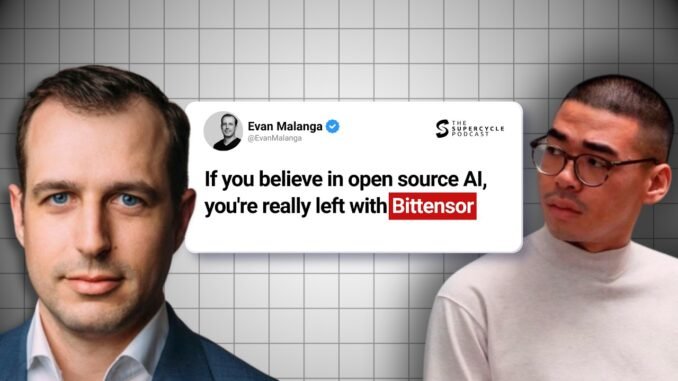
In a recent Super Cycle episode (watch below), Evan (Chief Revenue Officer at Yuma) gave one of the clearest breakdowns yet of how Yuma emerged inside the Digital Currency Group (DCG) empire, why Bittensor is winning the decentralized AI race, and what it will take to push the ecosystem into its next phase of adoption.
Yuma is not just another validator or investor in Bittensor. It has evolved into a full-stack ecosystem builder, combining validation infrastructure, subnet incubation, market access tools, and now institutional-grade asset management products. Evan’s conversation offers a direct look into how DCG recognized Bittensor early, why they doubled down, and what they’re building next.
How Yuma Started: From a DCG Working Group to a Full Business Line
Evan’s entry into Bittensor began in early 2024 when DCG leadership approached him with a clear directive. They had been exploring Bittensor internally but needed someone to take ownership full-time, go deep into the ecosystem, and build conviction. Evan stepped away from his previous responsibilities and went all in.
At the time, Bittensor had only 32 subnets. His early months were spent doing what every serious ecosystem builder should do: reading everything, meeting the core players, understanding the incentives, and identifying the bottlenecks stopping the network from scaling.
One major piece quickly fell into place. Foundry, another DCG subsidiary, already had a validator team running infrastructure across multiple chains. That team was also experimenting with Bittensor validation. Evan merged that operational foundation with his ecosystem research, and within a few months, Yuma began forming organically.
The First Breakthrough: Subnet Slots Were Too Expensive
Before dTAO, subnet registration was expensive. It could cost over 1,000 TAO to secure a slot, making it nearly impossible for early teams to launch. That was the lightbulb moment for Evan and the DCG.
Instead of watching promising builders get priced out, Yuma created a simple model: fund the subnet slot and bring the team onto the network. What surprised them was how immediate the demand was. Within 48 hours of thinking about the idea, they already had their first customer.
By the end of that summer, Yuma had helped five to six teams get on-chain. At first, they operated quietly, without marketing. But by fall 2024, the question was no longer “should we test this?” It became “should we scale this into a full company?”
That decision gave birth to Yuma officially in November 2024.
Why DCG Took Bittensor Seriously So Early
Evan explained that DCG didn’t fall for hype. They were skeptical at first, as anyone should be in crypto. But the numbers and structure of Bittensor forced them to pay attention.
At the time, Bittensor emissions were approaching $1 billion annually. More importantly, Evan noted that Bittensor’s emissions were roughly 4x larger than the total venture capital funding going into Web3 AI projects.
That imbalance mattered. It meant Bittensor had already created a capital engine bigger than what most venture-backed AI crypto projects could access.
Another major signal was how organic the ecosystem was. There was no heavy VC-driven marketing machine behind TAO. The protocol attracted builders because the incentives worked. Teams were showing up naturally, without needing brute force to pull them in.
That is rare in crypto, and DCG recognized it early.
How Yuma Picks Subnets Today
Yuma’s subnet incubation process has matured into something closer to an early-stage venture model.
Evan broke it down into three major filters.
First, the founder or founding team. Yuma places about 80% of its decision weight here. Most subnet teams are still pre-product, so execution quality matters more than any pitch.
Second, the problem being solved. Is it meaningful? Is it scalable? Will it generate adoption?
Third, the technical roadmap. Yuma evaluates incentive mechanism design, the state of development, and even performs code auditing when needed.
But above everything else, Yuma asks one question: will this subnet grow the Bittensor ecosystem and drive real adoption?
If the answer is no, it doesn’t matter how flashy the concept is.
The Big Gap in Bittensor Isn’t Technology, It’s Storytelling
One of Evan’s strongest points was simple and uncomfortable: Bittensor’s biggest weakness is not innovation, it’s communication.
Many subnets are producing real results, but the broader market doesn’t understand them.
Builders are juggling too much at once. They must design token incentives, handle a complex TAO paired market structure, manage community expectations, build a product, find customers, and scale commercial operations. Most founders don’t have the bandwidth to also become storytellers.
Evan believes the ecosystem will win faster once breakout subnets learn how to explain what they do in a way that investors, enterprises, and mainstream audiences can actually grasp.
From “Hands-Off Funding” to Full Incubation Support
In the early days, Yuma’s support model was simple: provide capital for the subnet slot and let teams run.
That approach evolved quickly. Today, Yuma offers a full menu of services.
They provide technical advisory through experienced operators who support incentive mechanism design. They support marketing and amplification, including media training and PR positioning. They help with fundraising by offering investor introductions and pitch support. They also run a vendor marketplace that provides subnet teams with discounted business tools, generating over $500,000 in savings across their portfolio.
Yuma is no longer just an incubator. It is an operating layer for subnet founders.
Why Bittensor Doesn’t Need to Compete with Silicon Valley Giants
A key moment in the conversation came when Evan addressed the “impossible comparison” people always make.
Many assume Bittensor must compete directly with billion-dollar Silicon Valley AI labs. Evan disagrees completely.
He said Bittensor doesn’t need to go toe-to-toe with companies that raised a billion dollars in VC funding. The goal is not to become the decentralized version of every centralized AI product. The goal is to create net new categories of innovation that centralized labs cannot produce.
That mindset shift is critical. Most projects fail because they chase existing categories instead of inventing new ones.
Bittensor’s advantage is not size, it’s structure. Open competition, decentralized coordination, and incentive-driven experimentation allow the ecosystem to build faster, cheaper, and in ways centralized teams cannot replicate.
Why Decentralized AI Can Still Win on Cost
Evan pointed to examples like Macrocosmos and Templar, where distributed training is being executed at a fraction of the cost compared to what centralized labs would pay.
Even if Bittensor is not always at state-of-the-art benchmarks yet, Evan believes open-source innovation will eventually reach parity, and then surpass centralized labs because it is more efficient and less capital intensive.
He emphasized that the breakthroughs are happening, but they are being drowned out by broader market rhetoric. People pay attention to trillion-dollar IPO rumors, not locked-in teams quietly building distributed training infrastructure from the ground up.
The Market Is Already Shaking Out Weak Subnets
Evan also explained that Bittensor is naturally filtering itself.
A year into dTAO, the ecosystem is seeing weaker, experimental subnets struggle to survive. The market is pushing the network into a barbell structure where only two categories win.
On one side are subnets hitting benchmarks and driving real technical progress. On the other side are subnets generating revenue and landing customers.
Everything in between is being squeezed.
This isn’t a flaw, it’s what markets do. Power laws exist everywhere, from venture portfolios to public equities. Bittensor is simply showing the same dynamics in real time.
Why Score Is a Standout Winner
When asked directly which Yuma incubated subnet is his personal favorite, Evan answered instantly: Score.
Score started as a niche project focused on football analytics. Today, it has expanded into manufacturing, agriculture, fuel, and industrial use cases, with a vision to make every camera intelligent.
Evan described Score’s progress as a home run. Their speed of iteration and expansion over the last year, especially the last three months, shows what happens when a subnet team combines technical execution with real-world market demand.
Why Yuma Launched Asset Management
The launch of Yuma Asset Management was driven by one simple reality: access.
Even after dTAO, it remains difficult for most investors to participate in the subnet economy. Major exchanges like Coinbase and Kraken may list TAO, but they don’t support subnet tokens. Institutional investors require custody solutions, reporting standards, and operational clarity. Meanwhile, tracking 128 subnets and rebalancing manually is unrealistic for most people.
Yuma solved this by creating simplified investment products for accredited investors.
Their subnet composite product works like an S&P 500 of subnets, market-cap weighted and rebalanced regularly. They also offer a large-cap product similar to the Nasdaq 100, focused on the top subnets.
Staking rewards are included automatically, meaning investors gain both exposure and yield without managing the complexity.
Evan shared that the composite product has outperformed TAO staked on route by roughly 25% since inception.
This is a major step toward bringing institutional liquidity into the subnet economy.
Why DATs and Institutional Access Are Bullish for TAO
Evan believes digital asset treasury companies and similar structures are net positive for Bittensor.
The reason is simple. Most institutional investors do not buy tokens directly. They buy regulated financial products through brokerage accounts, retirement vehicles, and custody-approved channels.
Products like Grayscale’s TAO trust and future ETF structures expand access to investors who would never touch Kraken or Binance. That broadens demand, increases legitimacy, and makes TAO more investable at scale.
The Most Important Risk: Slowing Down
When asked about risks, Evan gave a strong answer.
A year ago, the biggest risk was whether dTAO would work. Today, that risk is largely behind the ecosystem. The dTAO rollout was close to flawless, and the protocol is functioning.
Now, the real risk is complacency.
Bittensor has a head start. But if the ecosystem slows down, competitors will catch up. The priority must be sustaining momentum, attracting new builders, and helping breakout subnets become standalone businesses that the world recognizes, without needing to explain the subnet mechanics behind them.
The goal is for people to talk about “a world-class computer vision company” rather than “Subnet 44.”
The Biggest Goal for 2026: Community Alignment
Evan ended with what might be his most important point.
The next level for Bittensor will not be driven by one subnet or one innovation. It will be driven by alignment.
Clear governance, consistent messaging, and a unified value proposition are essential if Bittensor wants to scale beyond insiders and win mindshare globally. If the community can row in the same direction, the ecosystem will move faster than any centralized competitor.
Final Thoughts
This episode made one thing obvious. Yuma is not just investing in Bittensor. It is building infrastructure, access layers, and repeatable playbooks that push the entire protocol toward adoption.
And if the ecosystem maintains its pace, improves its storytelling, and stays aligned, Bittensor could become the strongest decentralized AI economy in the world.
Enjoyed this article? Join our newsletter
Get the latest Bittensor & TAO ecosystem news straight to your inbox.
We respect your privacy. Unsubscribe anytime.



Be the first to comment