

At some point, every crypto system is forced to confront a question that no amount of narrative can avoid, and it is usually the point where speculation gives way to reality: is the token actually backed by meaningful demand, or is it simply being sustained by emissions that outpace real usage?
Most projects only arrive at this realization much later in their lifecycle, often after liquidity has formed and incentives have already distorted the underlying economics, but Blockmachine approaches this problem from a very different angle by embedding economic discipline directly into its design from the outset.
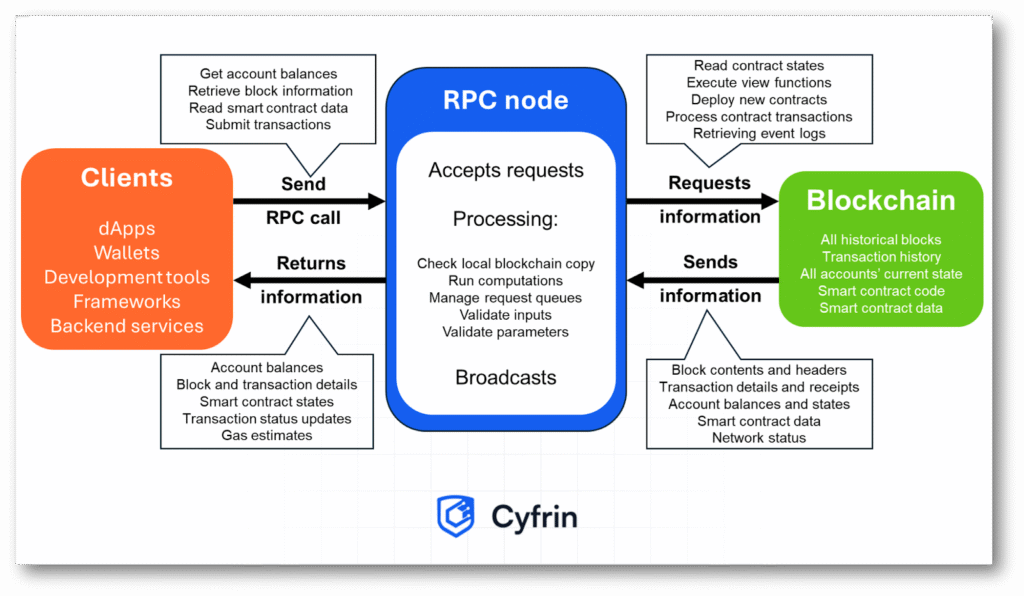
Blockmachine (Bittensor Subnet 19) is building a decentralized marketplace for blockchain RPC (Remote Procedure Call) and archive node infrastructure, positioning itself as a credible alternative to centralized providers such as Alchemy and Infura, while introducing a system where pricing, performance, and correctness are no longer opaque but instead verifiable through competition and auditability.
This leads us to a more precise framing of the question: If the infrastructure works as intended and demand materializes, does Subnet 19’s “$ALPHA” token meaningfully capture that value?
Answering this requires looking beyond surface-level metrics and examining how value is created, enforced, and sustained within the system.
What Blockmachine Actually Provides
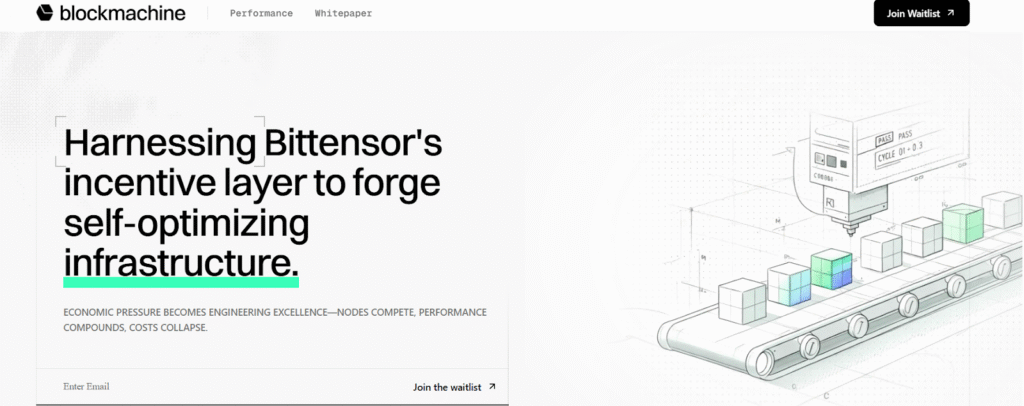
Blockmachine is not attempting to reinvent blockchain infrastructure, but rather to reorganize how access to that infrastructure is delivered, priced, and verified in a way that removes reliance on centralized intermediaries.
The protocol enables a decentralized network where independent operators provide RPC and archive node services, while a coordination layer ensures that real user requests are routed efficiently and evaluated continuously for correctness and performance.
In practical terms, the system which leverages Bittensor’s infrastructure composed of three interacting roles:
a. Miners, who supply the underlying infrastructure by running RPC and archive nodes and responding to incoming requests,
b. Validators, who independently audit these responses to ensure accuracy, reliability, and consistency over time, and
c. A protocol gateway, which acts as the entry point for user traffic, handling routing, metering, and enforcement.
What emerges from this structure is a marketplace where access to blockchain data is no longer dependent on trust in a single provider, but instead governed by measurable performance and competitive pricing.
Importantly, this is not a conceptual framework or a future roadmap item, as the network is already live, actively routing requests, and beginning to integrate with real data consumers.
The Structural Problem It Solves
The dominance of centralized RPC providers today is not accidental, as they offer simplicity, reliability, and deep integration into existing developer workflows, but their model introduces several structural inefficiencies that become more apparent as the ecosystem scales.
These inefficiencies can be summarized as follows:
a. Pricing models are often opaque and not directly tied to the actual computational work performed,
b. Users are required to trust that responses are correct without any independent verification,
c. Infrastructure remains concentrated among a small number of providers, creating both technical and governance risks, and
d. Switching costs and ecosystem dependencies make it difficult to move away from incumbents.
Blockmachine addresses these issues by reframing RPC access as a competitive marketplace where correctness is enforced through verification, pricing emerges from supply and demand, and performance is continuously measured rather than assumed.
Where Does the $ALPHA Derive Its Value?
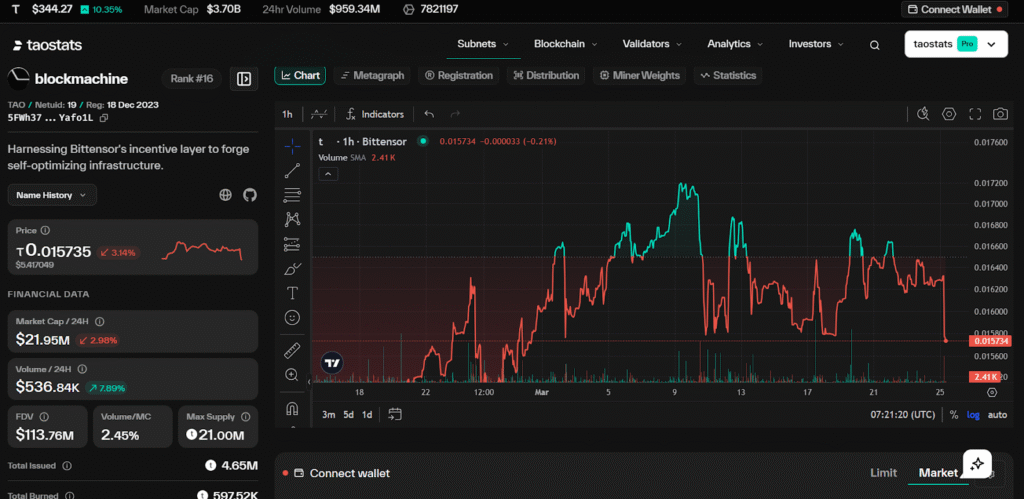
Understanding whether the token holds value requires tracing how it interacts with the system, particularly how it connects to real usage rather than existing as a separate speculative layer.
Several mechanisms work together to ensure that value is not abstract, but instead tied directly to economic activity within the network.
1. Rewards Are Strictly Tied to Delivered Work
Unlike many systems where participation alone can generate rewards, Blockmachine ensures that miners only earn when they successfully complete meaningful work, which in this case means serving valid RPC responses to real user requests.
This design introduces a strict filter on value creation:
a. Responses that fail or return errors do not generate revenue,
b. Incorrect data is penalized through validator audits, and
c. Only successful and verified outputs contribute to earnings.
As a result, emissions are not distributed passively, but instead earned through measurable contribution, creating a direct link between network usage and token distribution.
2. Pricing Is Anchored to Real-World Costs
A defining feature of Blockmachine’s economic model is that pricing is denominated in USD per unit of work, rather than in the native token itself, which introduces a level of discipline that is often absent in tokenized systems.
This approach ensures that:
a. Pricing reflects actual infrastructure costs rather than speculative token movements,
b. Users can reason about expenses in familiar terms without exposure to volatility, and
c. The marketplace behaves more like a commodity market than a purely crypto-native system.
The token, therefore, does not dictate pricing, but instead operates within a system where pricing remains grounded in reality.
3. Supply Contracts When Demand Falls Short
One of the most important mechanisms in the system is the introduction of automatic emission burns, which activate whenever network demand does not fully absorb the available token emissions.
In such cases:
a. The unused portion of emissions is permanently removed from supply, and
b. Token inflation is effectively counterbalanced by lack of demand.
This ensures that idle capacity does not lead to unchecked dilution, and that the token supply dynamically adjusts in response to actual usage rather than theoretical participation.
4. Market Activity Offsets Sell Pressure
In addition to managing supply, Blockmachine also addresses the issue of sell pressure, which is a common weakness in many token economies where rewards are immediately liquidated.
Through the Protocol Stability Reserve (PSR):
a. Tokens corresponding to miner rewards are purchased from the market, and
b. These tokens are held in reserve rather than reintroduced into circulation.
This mechanism reduces the impact of continuous selling while linking token demand to network revenue, creating a feedback loop where increased usage translates into increased market activity.
Why This Design Holds Up
When these mechanisms are considered together, a clear pattern emerges such that rewards are earned through real work, supply adjusts when demand is insufficient, and market activity absorbs potential downward pressure.
Simply put, this leads to a system where the token is continuously shaped by how much the network is actually used.
The strength of $ALPHA lies not in any single mechanism, but in how these mechanisms reinforce one another to create a more balanced and resilient economic system.
By tightly coupling work and rewards, demand and supply adjustments, and revenue and market participation; Blockmachine reduces the gap between utility and token behavior, which is where many other systems tend to break down.
Current State and Forward Momentum
While still early in its lifecycle, Blockmachine has already moved beyond the purely developmental stage and begun operating in a live environment. Recent progress includes:
a. Deployment as an active Bittensor subnet serving real RPC traffic,
b. Integration with platforms such as Taostats for performance visibility,
c. Continuous improvements to miner onboarding and validator systems, and
d. Ongoing work toward stablecoin-based payments and multi-chain support.
These developments indicate a transition from infrastructure build-out toward real economic activity, which is the phase where token value becomes more meaningfully tested.
Dox or Undoxed: The Team Behind Blockmachine (Bittensor Subnet 19)
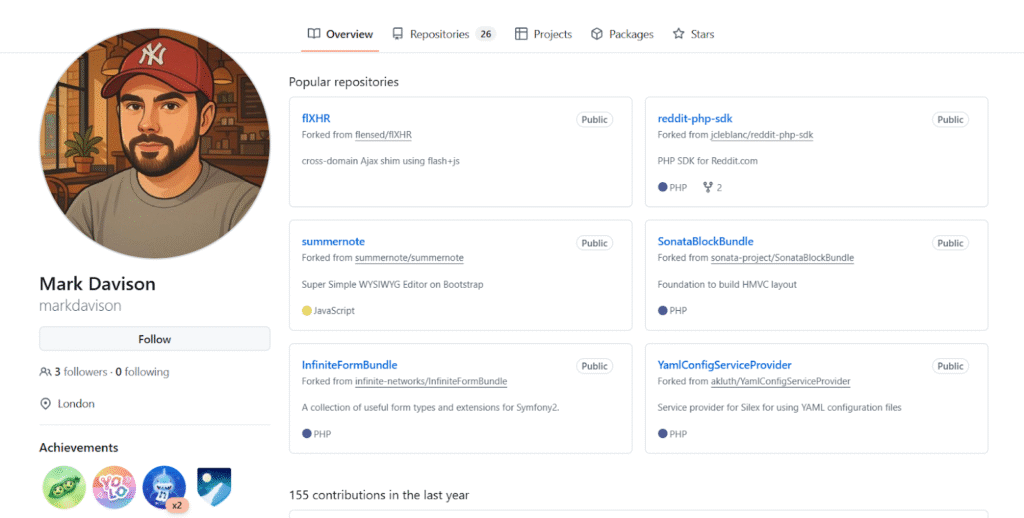
The project is currently led by Mark Davison, who serves as the primary contributor and maintainer of the codebase, with development progressing through iterative releases and public tooling.
Also, the team has been actively communicating developments within the ecosystem through their official social platforms.
While the team “might be relatively small,” this is not unusual for early-stage infrastructure projects, although future growth in contributors will be important as the system expands in scope and complexity.
Risks and Open Questions
A balanced view requires acknowledging that several uncertainties remain:
a. Adoption must scale for demand to fully materialize,
b. Competition from established providers remains strong,
c. The system is still early in its development cycle, and
d. Execution across multiple chains will introduce additional complexity.
However, the design itself is structured to reward efficiency and penalize underperformance, which provides a stronger foundation than many comparable systems.
NFA: A Token That Reflects Usage, Not Narrative
Subnet 19’s $ALPHA does not derive its value from speculation or abstract promises, but from a set of mechanisms that tie it directly to real economic activity within the network.
Its value is shaped by:
a. The volume of RPC requests being served,
b. The competitiveness of pricing within the marketplace,
c. The reliability and correctness of infrastructure providers, and
d. The balance between emissions and actual demand.
If Blockmachine succeeds in scaling usage across chains and regions, the token evolves into something much simpler and more meaningful: A direct reflection of how much decentralized infrastructure is being consumed.
In a market where many tokens struggle to justify their existence beyond narrative, that level of alignment between product and value is not just rare, but increasingly necessary.
NFA Alert: Prospective investors should note that this is not financial advice. Thus, users are advised to conduct deep fundamental and technical analysis before investing in the $ALPHA.
Useful Resources
To track Blockmachine’s progress, follow:
a. Official Website: https://blockmachine.io/,
b. X (Formerly Twitter): https://x.com/blockmachine_io,
c. Discord: https://discord.com/channels/799672011265015819/1414687189752746167,
d. GitHub: https://github.com/taostat/blockmachine, and
e. Whitepaper: https://blockmachine.io/blockmachine-whitepaper.pdf.
Enjoyed this article? Join our newsletter
Get the latest Bittensor & TAO ecosystem news straight to your inbox.
We respect your privacy. Unsubscribe anytime.
Be the first to comment