
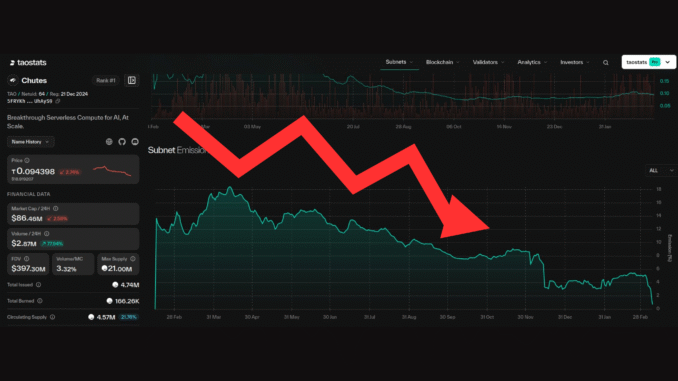
If you’ve been watching the Chutes emissions chart over the past few weeks, the situation is glaring: its share of Bittensor emissions has dropped to levels not seen since dTAO launched in February 2025. The community is asking what’s wrong. We think they’re asking the wrong question.
The better question is: what is the emissions drop actually telling us about where Chutes is headed?
First, understand the mechanics
Under Bittensor’s Taoflow model, which replaced the old price-based emissions formula in November 2025, a subnet’s share of daily TAO emissions is determined by its net inflow of staked TAO, smoothed by an exponential moving average with a roughly 30-day half-life.
In that vein, emissions don’t track how good your product is. They track how much fresh capital is flowing in versus flowing out.
That distinction matters enormously. When investors rotate out of a subnet — even temporarily, even for reasons that have nothing to do with fundamentals — the emissions chart craters. And with the December 2025 halving cutting daily network-wide issuance from approximately 7,200 TAO to 3,600, every unit of outflow now hits twice as hard.
This is exactly what’s been happening to Chutes. The emissions decline is not a product story. It’s a capital-rotation story.
The sell pressure is structural and well understood
Miners sell. This is not essentially a bad thing, but an operating reality. Running GPU infrastructure — particularly the H100 and A6000-class hardware that powers Chutes — costs real money. Miners convert a portion of their TAO rewards to fiat to cover server leases, electricity, and bandwidth. By some estimates, miner sell pressure alone accounts for around 30% of emission outflows, and that percentage is baked into the system by design.
Meanwhile, the product has never been stronger
Here’s where the disconnect becomes genuinely interesting. While emissions have been sliding, Chutes has been shipping the most consequential upgrades in its history.
The headline feature is the public launch of Trusted Execution Environments (TEEs), powered by a custom security-hardened Kubernetes distribution called sek8s. This isn’t marketing fluff. Chutes’ TEE implementation means even Chutes cannot inspect the data being processed. GPU traffic is further protected through NVIDIA’s Protected PCIe, which encrypts the data channel between CPU and GPU. The entire chain is cryptographically attested: boot measurements, runtime environment, and model integrity can all be verified remotely.
No other decentralized inference platform offers this level of hardware-rooted privacy for AI workloads. Not Venice, which relies on on-device encryption and decentralized routing but does not provide verifiable confidential compute at the hardware level. Not Akash, which offers a general-purpose compute marketplace. Not Render, which focuses on GPU rendering. Not ICP, which only recently passed its first TEE-enabled subnet proposal and is still in a restricted test phase with seven nodes.
Chutes is already running TEE-protected models in production at scale — including DeepSeek V3.2 Speciale TEE and others — serving over 400,000 users and processing an estimated 160 billion tokens daily. The platform operates at roughly 85–90% lower cost than comparable AWS infrastructure. It ranks as the leading inference provider on OpenRouter, outperforming centralized competitors.
The market hasn’t priced any of this in
This is the core thesis, and it’s worth stating plainly: Chutes has evolved from a simple serverless inference API into a full-stack confidential AI compute platform with end-to-end verifiable privacy, and the market is still pricing it as if it’s a basic model-hosting subnet.
Consider what Chutes now offers that it didn’t six months ago: TEE-protected inference with hardware attestation, AI-powered search, consumer applications like Chutes Chat and Chutes Studio, batch processing and long-running jobs, a startup accelerator with up to $20,000 in credits, and GDPR/CCPA-compliant architecture by design. The platform has also been adjusting its revenue model — retiring the free Early Access tier that gave users 200 daily requests, moving resource-intensive frontier models to paid tiers, and transitioning toward sustainable pricing.
That last point is critical. Users who were enjoying zero-cost access to state-of-the-art models are understandably unhappy. But subsidized usage was never the business model. It was a bootstrapping mechanism, and its retirement is a sign of maturation of the product.
Yes, there was instability — and here’s why
It would be dishonest to pretend the past few weeks have been smooth. They haven’t. The Chutes team rolled out the most significant security and infrastructure upgrade since launch — upgrading all Chutes versions and miner TEE servers simultaneously. That’s the equivalent of performing open-heart surgery on a running system. Some turbulence was inevitable.
Compounding the situation, GPU inventory has been constrained. The team has publicly acknowledged a global GPU shortage affecting their ability to scale capacity. Fewer GPUs on the miner side means reduced throughput, which affects reliability metrics, which affects user sentiment, which affects staking flows, which affects emissions. The feedback loop is vicious in the short term — but it’s also self-correcting. As the upgrade stabilizes and GPU supply normalizes, the system rebalances.
The bigger picture: Bittensor’s Darwinian turn
Zoom out further and the context becomes even more favorable for Chutes. Bittensor’s 2026 story is one of quality over quantity. The OpenTensor Foundation has capped total subnets at 128, with new entrants replacing the lowest performers. A four-month immunity period gives newcomers a runway, but after that, it’s survival of the fittest. Emissions are now explicitly Darwinian: if a subnet doesn’t attract genuine user engagement and staking inflows, it gets zero emissions and eventually gets deregistered.
Chutes is not at risk of deregistration. It remains the highest-emission subnet in the Bittensor ecosystem and has consistently ranked as the network’s flagship product. Institutional analysts at Grayscale and Crypto.com have specifically highlighted it as a leading example of real-world utility in decentralized AI. The subnet was valued at approximately $91.8 million as of late 2025, and the broader Bittensor ecosystem continues to mature around it.
Our take
Emissions are a lagging indicator of capital flows, not a leading indicator of product quality. Chutes’ emissions are at a post-dTAO low because investors rotated, TAO’s price dumped, and the platform underwent a major infrastructure overhaul — all at the same time. None of those factors reflect a deterioration in what Chutes actually does.
What Chutes actually does, as of this week, is provide the most advanced confidential AI inference platform in the decentralized ecosystem — one that processes trillions of tokens monthly, serves hundreds of thousands of users, offers hardware-attested privacy guarantees that no competitor can match, and does it all at a fraction of centralized cloud pricing.
The market will catch up. It usually does. But if you’re looking at the emissions chart and concluding that Chutes is in trouble, you’re reading the wrong chart.
Read the product.
Disclaimer: This article represents the editorial opinion of The Tao Daily. It is not financial advice. The views expressed are based on publicly available information and community commentary, including analysis shared by Alex DRocks (@DrocksAlex2). Readers should conduct their own research before making investment decisions.


Be the first to comment