
INSIDE THE VIDEO:
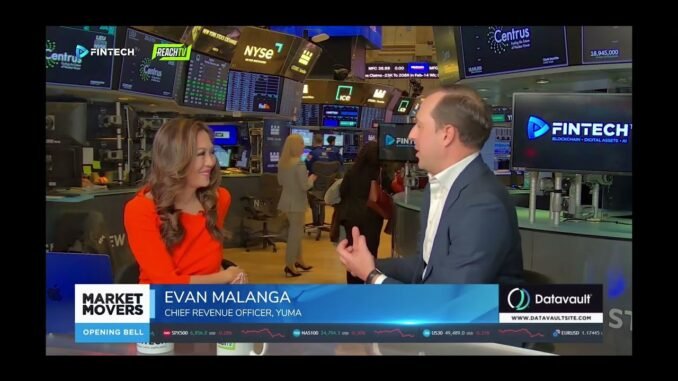
At the New York Stock Exchange (NYSE), Evan Malanga, Chief Revenue Officer of Yuma (a subsidiary of Digital Currency Group), laid out a thesis: artificial intelligence, as it exists today, is a capital sinkhole. Massive capex, opaque accounting, closed systems, and little residual value for anyone outside a handful of Silicon Valley incumbents. Yuma’s bet is that decentralized AI can flip that model and turn intelligence into an investable, yield-generating asset class.
The Problem With Centralized AI
AI capital is concentrating into a small cluster of firms. Billions flow into closed systems with rising barriers to entry. Builders struggle to access model weights and data. Investors get limited exposure unless they’re inside late-stage private rounds. The structure favors incumbents and locks out inclusivity. According to Malanga, this creates both innovation bottlenecks and access problems. The economic upside accrues to a narrow set of balance sheets, while the broader ecosystem remains dependent on them.
Decentralized AI and the Bittensor Model
Yuma is building within the Bittensor network, which Malanga describes as analogous to what the internet did for information, opening access, except applied to intelligence. Instead of a few corporations owning the stack, Bittensor creates a protocol layer where independent participants contribute and compete. Builders launch “subnets,” effectively opening AI markets. Miners provide compute and model outputs. Validators score performance and allocate incentives. The TAO token acts as the economic engine coordinating the entire system. Like Bitcoin, Bittensor has a 21 million token cap and a halving cycle, reinforcing a hard-supply design and a work-based issuance model. You earn by producing value on the network.
Real-World Performance and Speed
Malanga pointed to concrete examples of subnets already supported by Yuma: computer vision models claiming dramatic efficiency gains versus centralized peers; agent platforms hitting state-of-the-art software engineering benchmarks; open-source projects moving from inception to fully functional products in a matter of weeks.
TradFi Meets Tokenized Intelligence
Looking forward, Malanga expects the boundary between traditional finance and crypto to dissolve. Tokenization is already being discussed at the highest levels of asset management. What once sounded speculative (putting real-world assets on-chain) is now an institutional strategy. In his view, the same creep will occur with decentralized AI infrastructure. Over time, there won’t be “DeFi” and “TradFi.” There will just be finance running on tokenized rails.
Enjoyed this article? Join our newsletter
Get the latest Bittensor & TAO ecosystem news straight to your inbox.
We respect your privacy. Unsubscribe anytime.


Be the first to comment