
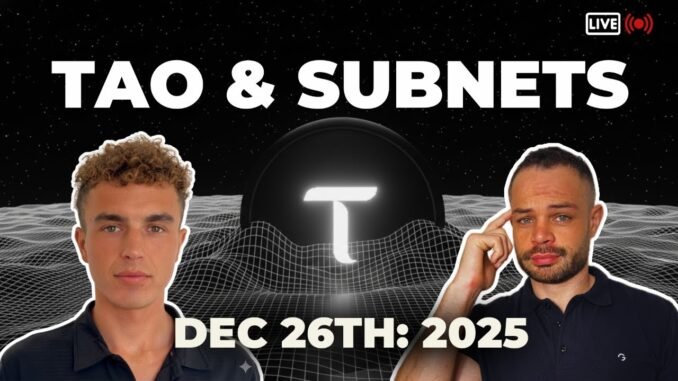
Bittensor has entered a quieter phase: Not because momentum has disappeared, but because the system is recalibrating.
The first $TAO halving is now behind the ecosystem. Emissions have been cut, subnets are competing harder for attention and capital. Yet price action across crypto remains sluggish, even as equities and precious metals push to new highs.
In a wide ranging discussion, Gordon Frayne welcomed Jared Lawrence of Beyond Finance back to the channel to break down what this moment really represents. The conversation (watch below) moved well beyond short-term charts, touching on liquidity cycles, capital rotation, subnet economics, and why the coming twelve months may matter more than any single-price candle.
A Market Sending Mixed Signals
Gordon opened by highlighting a growing disconnect that Bitcoin has remained range bound and volatile, while gold, silver, and major equity indices continue to strengthen.
For many market participants, this divergence feels unsettling.
Jared framed the situation through a familiar lens. Crypto, he argued, remains highly sensitive to leverage and liquidity events. The October liquidation was not unusual in structure, but extreme in execution. Rapid deleveraging forced many participants out of positions before they had time to react.
At the same time, traditional markets told a very different story.
This kind of divergence, Jared noted, rarely persists. When correlations break, they tend to snap back. Historically, crypto does not lead these shifts. It lags, then accelerates.
Why Small Caps and Metals Matter for Crypto
Rather than focusing solely on Bitcoin ($BTC), Jared pointed to broader signals.
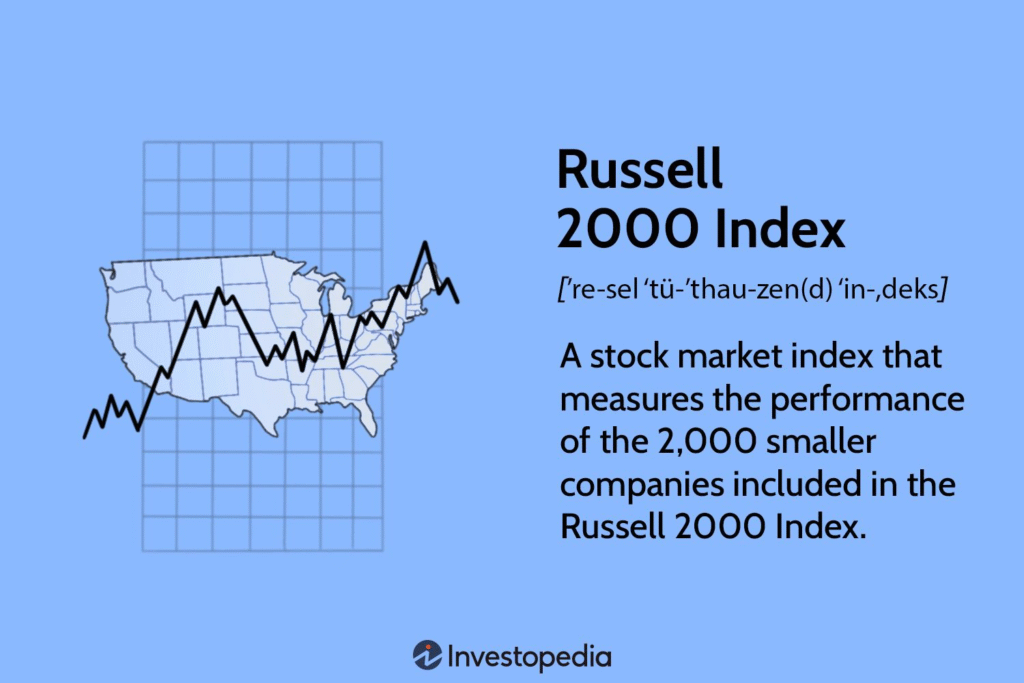
Russell 2000, which tracks small cap equities, has quietly strengthened. In past cycles, this has often preceded a broader risk on environment. When capital rotates out of defensive assets and into smaller, higher volatility plays, crypto typically follows.
Gold and silver, meanwhile, appear extended. Jared suggested that if metals begin to roll over, the resulting capital flow could re-enter risk assets, including $BTC.
Gordon summarized the implication simply noting that crypto may not be broken, it may just be early.
The Halving Was Never About Immediate Price
When the discussion shifted to Bittensor ($TAO) itself, both speakers agreed that expectations around the halving were misunderstood.
Jared emphasized that reducing emissions is not designed to create instant scarcity. It was meant to apply pressure slowly, forcing capital to become more selective over-time. Inefficient designs feel the strain first and productive systems endure.
Ahead of the halving, many participants moved capital back (from subnets) to root as a defensive measure. Since then, Jared has observed capital gradually returning to subnets with proven activity and clearer value propositions.
Gordon noted that this behavior reflects the core philosophy of Bittensor. Incentives are not expected to be static; they adapt, and participants adapt with them.
A Shift Back to Proven Subnets
One of the strongest themes was the rotation back toward established subnets. Many early subnets experienced deep drawdowns not because they failed, but because uncertainty drove de-risking. As that uncertainty fades, those same subnets are beginning to stabilize.
Jared explained why this matters. He rightly submitted that subnets with real throughput, revenue potential, and disciplined token mechanics are better equipped to survive tighter emission environments. Newer or less focused designs face a steeper challenge.
This is not consolidation driven by hype. It is consolidation driven by economics.
When Token Design Overrides Technical Analysis
Some subnets, Jared noted, are defying conventional chart patterns entirely.
Instead of moving in cycles, they trend steadily upward. The reason lies in their internal token mechanics.
Buyback and burn strategies, combined with controlled issuance, create structural demand that can outweigh short-term sentiment.
Gordon stressed that while no mechanism is permanent, these examples highlight an important shift. In Bittensor ($TAO), market structure increasingly reflects incentive design rather than speculation alone.
Risk Management in a High Velocity System
Both speakers emphasized discipline. Jared described a portfolio framework that separates long-term subnet exposure from shorter term, higher velocity strategies. He opined that active trading generates liquidity while core positions compound over time.
This structure, he argued, reduces emotional decision making and acknowledges the uneven liquidity across subnets.
Gordon added that opportunity cost is real, but unmanaged risk compounds faster than missed upside.
New Financial Tools are Changing the Game
The conversation also touched on emerging primitives within the ecosystem.
It highlights that perpetual markets and prediction markets are beginning to appear, offering new ways to hedge exposure and isolate yield. While still early, these tools signal a maturing financial layer around Bittensor.
Jared welcomed the innovation but urged caution noting that liquidity, transparency, and user discipline will determine whether these systems become reliable or remain experimental.
Still, both agreed that such developments are inevitable as the ecosystem grows.
Looking Toward 2026
As the discussion closed, Gordon posed the question many in the community are asking: What happens next?
Jared pointed to an important milestone. He explained that by early 2026, most subnets will have a full year of operating history and that matters. It allows markets to separate signal from noise and productivity from promise.
If broader liquidity improves and Bitcoin ($BTC) resumes its expansion, the downstream effects on $TAO and subnets could be significant. But even without that, Jared emphasized that value creation within the network continues regardless of price.
Final Takeaway
The conversation revealed that Bittensor ($TAO) is not in decline but in selection mode.
The halving did not remove opportunity, it refined it. Capital is becoming more intentional. Incentives are doing their job.
As Gordon concluded, he submitted that few ecosystems allow participants to build, earn, and compound simultaneously. And for those willing to think beyond short-term volatility, this phase may prove far more important than it feels today.
Enjoyed this article? Join our newsletter
Get the latest Bittensor & TAO ecosystem news straight to your inbox.
We respect your privacy. Unsubscribe anytime.


Be the first to comment