
As generative AI models become more capable, distinguishing real content from synthetic media is becoming increasingly difficult. Images, videos, and biometric data can now be convincingly fabricated at scale, creating serious risks for media integrity, identity verification, and enterprise security.
BitMind, Subnet 34 on the Bittensor network, is built to address this challenge.
Operating as a decentralized, incentive-driven detection network, BitMind uses advanced generative and discriminative AI models to identify AI-generated media.
By leveraging Bittensor’s competitive architecture, the subnet continuously improves detection quality while avoiding the stagnation common in centralized systems.
What BitMind Does
BitMind focuses on detecting synthetic content across multiple formats, starting with AI-generated images and expanding into video, biometrics, and identity data.
Key characteristics include:
a. Decentralized model competition that rewards accuracy and performance,
b. Continuous adaptation to new generative techniques, and
c. API (Application Programming Interface) and UI (User Interface) access for developers, enterprises, and consumers.
This structure allows BitMind to evolve alongside the threat landscape, rather than falling behind it.
Traction and Progress
Since launch, BitMind has moved beyond experimentation into real-world usage. Notable achievements include:
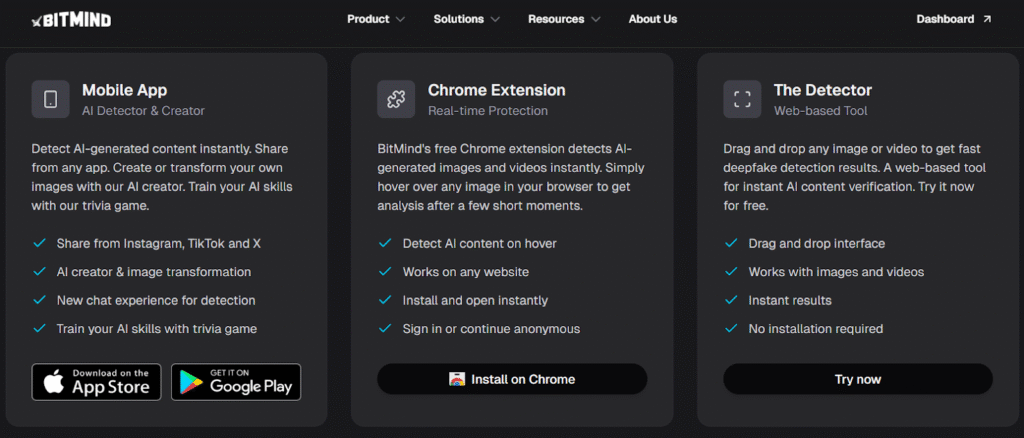
a. Video detection and integration capabilities,
b. Mobile apps on iOS and Android,
c. Revenue from API access and premium tiers,
d. Over 150,000 monthly active users, and
e. A subnet refactor to a scalable GAS (Generative Adversarial Subnet) architecture.
These milestones reflect growing demand for reliable AI detection tools.
2026 Focus: Enterprise-Grade Detection
BitMind’s 2026 roadmap prioritizes enterprise adoption and deeper infrastructure capabilities. Planned enhancements include:
a. Support for larger models and Safetensors,
b. Biometric and proof-of-human challenges,
c. Document forgery detection for regulated industries, and
d. Explainability and forensic tooling.
On the product side, BitMind is expanding into:
a. Video meeting and VoIP (Voice over Internet Protocol) integrations,
b. Enterprise database scanning with privacy-first design, and
c. KYC (Know Your Customers) and KYB (Know Your Business) identity verification with built-in forgery detection.
Why it Matters for Bittensor
Synthetic media detection is an adversarial problem. This infers that as generators improve, detectors must improve faster.
BitMind uses Bittensor’s incentive mechanisms to turn detection into a live, competitive market where better models earn more and weak ones are replaced. This makes Subnet 34 a natural fit for Bittensor’s vision of decentralized, continuously improving AI infrastructure.
Looking Ahead
As synthetic content becomes cheaper and more convincing, trust infrastructure will be essential. BitMind is positioning itself as a core layer for verifying digital authenticity at scale.With proven traction, real revenue, and a focused push toward enterprise adoption, BitMind is evolving into one of the most practical trust-focused subnets within the Bittensor ecosystem.


Be the first to comment