Bitcoin traders today were spooked by the mother of all mysterious Bitcoin whales.
The price of Bitcoin fell from above $109K to near $107K.
But the macro picture and technical indicators suggest the Bitcoin bull run is far from over, despite short-term price action.
War, geopolitical uncertainty, President Donald Trump’s “Big Beautiful Bill”—with so much going on, what could possibly be shaking the Bitcoin market today? How about one of the biggest Bitcoin holders in history suddenly moving $8 billion from their wallet? Yikes.
The crypto community was shaken today by the movement of 80,000 BTC—worth approximately $8.6 billion at today’s prices—from wallets that had remained dormant for over 14 years. This “OG” holder, who controls the funds across eight wallets, received their coins in April and May 2011—way back when Bitcoin traded between $0.78 and $3.37. Talk about diamond hands.
The entity—whoever it, he, she, they are—had accumulated up to 200,000 BTC at one point in 2011, representing what would be $22 billion today. That puts this whale in the top five Bitcoin holders of all time, according to Coinbase Director Conor Grogan. The Coinbase exec initially speculated that the wallets could belong to an unmarked crypto exchange, then said it was more likely a very early Bitcoin miner, before landing on it possibly being the result of a hack. Oh boy.
The timing of the move, on a U.S. holiday weekend when “everyone is at the beach,” has also raised eyebrows and stirred speculation across Crypto Twitter about potential market manipulation.
Needless to say, skittish Bitcoin traders didn’t like this one bit, as the price of Bitcoin fell from above $109,000 to around $107,500 following news of the OG whale’s moves. This won’t be welcomed news to the 40% of users over on Myriad, a prediction market developed by Decrypt’s parent company Dastan, who predicted the price of Bitcoin would stay above $108,000 by the end of the week. But to the 59% of bears who said Bitcoin would dip, congrats.
So where could Bitcoin go from here in the long-term? Let’s take a look at the charts.
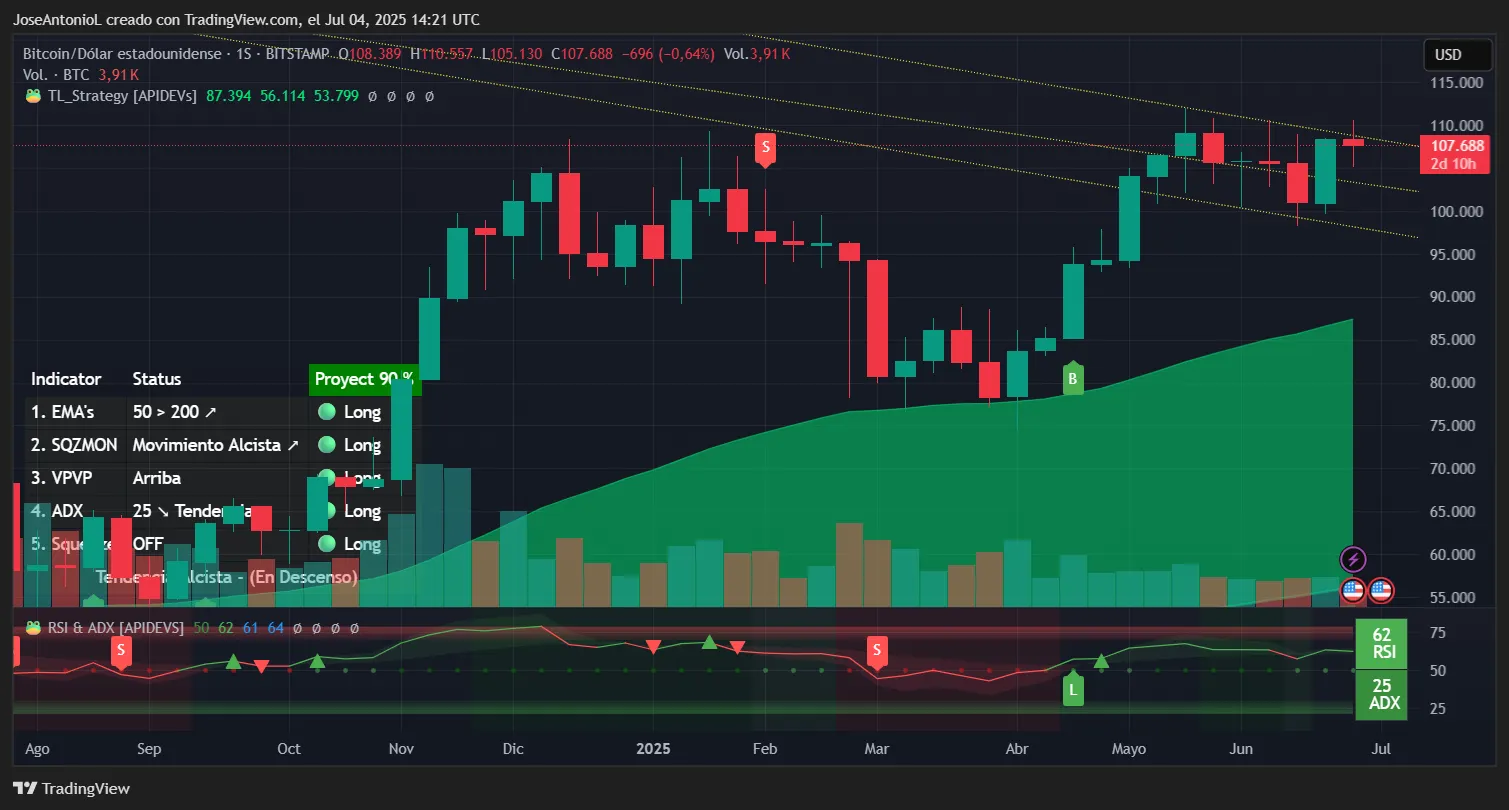
Bitcoin price data. Image: TradingView
Short-term traders appear to be taking profits after Bitcoin’s 15% rally over the past 60 days, creating a “sell the news” dynamic. The cryptocurrency faces immediate technical resistance at the $110,561 swing high from June 27, unable to break past the resistance of a short bearish channel that has been in play for seven weeks already.
The Average Directional Index, or ADX, which measures how strong or weak a price trend is, reads 25—sitting exactly at the threshold that typically separates choppy, directionless markets from trending ones. Think of ADX as a trend strength meter: below 25 means weak or no trend, above 25 indicates a trend is developing, and above 40 signals a very strong trend.
The Exponential Moving Averages, or EMAs, also tell a bullish story despite recent weakness. EMAs usually behave like dynamic support and resistance levels that give more weight to recent prices. The 50-period EMA (the faster-moving average, measuring the average price of the last 50 weeks) sits at $87,394, while the 200-period EMA (the slower, more significant one) is way down at $56,114. When price trades above both EMAs and they’re rising, it confirms an uptrend. Bitcoin remains well above both, maintaining its long-term bullish structure.
The Relative Strength Index, or RSI, currently reads 62. RSI measures momentum by comparing recent gains to recent losses on a scale of 0-100. Readings above 70 suggest the asset might be moving up too fast (overbought), while below 30 indicates it might be oversold. At 62, Bitcoin shows moderate upward momentum with room to run higher before becoming overheated.
The Squeeze Momentum Indicator shows there is still a solid bullish trend in play. This indicator identifies when volatility is expanding after being compressed—like a spring being released. When the squeeze is “off,” it means volatility is increasing, and the green signal suggests the likely direction is upward.
In other words, indicators show that, for now, position traders and hodlers are still bullish, despite the current bearish mood among short-term traders.
Websites store cookies to enhance functionality and personalise your experience. You can manage your preferences, but blocking some cookies may impact site performance and services.
Essential cookies enable basic functions and are necessary for the proper function of the website.
Name
Description
Duration
Cookie Preferences
This cookie is used to store the user's cookie consent preferences.
30 days
These cookies are needed for adding comments on this website.
Name
Description
Duration
comment_author
Used to track the user across multiple sessions.
Session
comment_author_email
Used to track the user across multiple sessions.
Session
comment_author_url
Used to track the user across multiple sessions.
Session
Statistics cookies collect information anonymously. This information helps us understand how visitors use our website.
Google Analytics is a powerful tool that tracks and analyzes website traffic for informed marketing decisions.
Contains information related to marketing campaigns of the user. These are shared with Google AdWords / Google Ads when the Google Ads and Google Analytics accounts are linked together.
90 days
__utma
ID used to identify users and sessions
2 years after last activity
__utmt
Used to monitor number of Google Analytics server requests
10 minutes
__utmb
Used to distinguish new sessions and visits. This cookie is set when the GA.js javascript library is loaded and there is no existing __utmb cookie. The cookie is updated every time data is sent to the Google Analytics server.
30 minutes after last activity
__utmc
Used only with old Urchin versions of Google Analytics and not with GA.js. Was used to distinguish between new sessions and visits at the end of a session.
End of session (browser)
__utmz
Contains information about the traffic source or campaign that directed user to the website. The cookie is set when the GA.js javascript is loaded and updated when data is sent to the Google Anaytics server
6 months after last activity
__utmv
Contains custom information set by the web developer via the _setCustomVar method in Google Analytics. This cookie is updated every time new data is sent to the Google Analytics server.
2 years after last activity
__utmx
Used to determine whether a user is included in an A / B or Multivariate test.
18 months
_ga
ID used to identify users
2 years
_gali
Used by Google Analytics to determine which links on a page are being clicked
30 seconds
_ga_
ID used to identify users
2 years
_gid
ID used to identify users for 24 hours after last activity
24 hours
_gat
Used to monitor number of Google Analytics server requests when using Google Tag Manager


Be the first to comment