

In the race for real-time AI translation, Babelbit (Subnet 59) is attempting something ambitious called Predictive Semantic Modelling. Instead of waiting for a speaker to finish a sentence (which causes awkward delays), Babelbit’s AI predicts where the sentence is going and starts translating before the speaker finishes.
It is the difference between a sluggish subtitles track and a seamless, human-like conversation.
On February 17, 2026, the team announced a major overhaul to their incentive mechanism. The goal? To stop miners from “gaming” the leaderboard with theoretical models and force them to ship code that actually works in the real world.
What is Babelbit (SN59)?
Babelbit (Subnet 59) is a decentralized network on the Bittensor blockchain dedicated to solving the problem of real-time, low-latency speech-to-speech translation in global communication.
While tools like Google Translate are excellent for text, they struggle with live conversation. Traditional systems use a “cascade” approach: they record speech, transcribe it to text, translate the text, and then synthesize it back into speech. This process creates a delay of several seconds, which kills the natural flow of conversation.
Babelbit eliminates this lag by building the “Universal Translator”, a system fast enough to handle live broadcasts, international conferences, and emergency calls without the awkward silence.
What They Do
Babelbit’s core innovation is Predictive Semantic Modelling. Instead of waiting for a speaker to finish a sentence, Babelbit’s AI anticipates what they are going to say next.

In languages like German, the verb often comes at the very end of the sentence. A traditional translator has to wait for silence to make sense of the meaning. Babelbit, however, uses advanced Large Language Models (LLMs) to predict the outcome in real-time, beginning the translation before the speaker has even finished their thought.
This allows for ”Speed of Thought” translation, targeting a latency of just ~50 milliseconds. Ideally, this makes the translation feel instantaneous, allowing two people to converse naturally as if they were speaking the same language.
The Update: “The Arena”
In decentralized AI (like Bittensor), a common issue is “over-fitting”, where miners build models that score high on specific tests but fail in live production. Babelbit just killed that strategy with a new Two-Round Incentive Model.
Round 1: The Audition (Qualifying)
- The stakes: 20% of total rewards.
- The process: An open competition where all miners submit their models.
- The result: The top performers don’t just win a small slice of TAO; they earn a ticket to the main event.
Round 2: The Reality Check (The Arena)
- The stakes: 80% of total rewards.
- The process: This is the game-changer. The Babelbit team takes the exact code submitted in Round 1 and deploys it themselves on their own infrastructure.
- The test: They re-run the benchmarks. If the model fails, crashes, or performs worse than it did in the open round, the miner gets zero rewards for this tier.
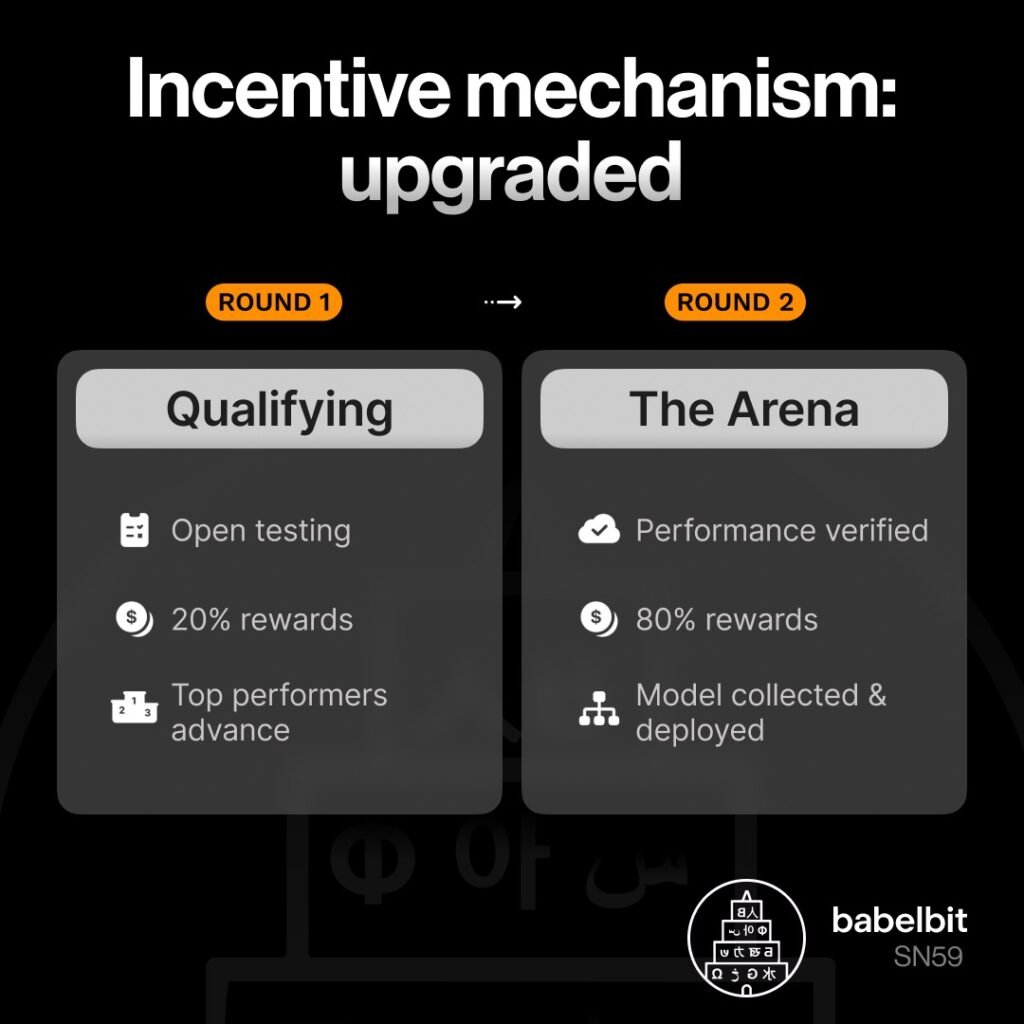
This shifts the meta from “optimize for the leaderboard” to “optimize for production.” As the team put it in their announcement: “The safest way to win remains simple: build something genuinely strong – and back it all the way.”
Why It Matters
This update isn’t just bureaucratic; it is a technical necessity. Babelbit is targeting low-latency speech-to-speech, a sector where “faking it” is impossible.
- The Tech: Their system targets ~50ms latency (faster than the blink of an eye).
- The Use Case: Because it prioritizes speed and reliability, Babelbit is built for high-stakes environments e.g. live sports broadcasting, international conferences, and emergency call centers.
- The Problem: If a miner submits a model that scores high on accuracy but requires massive compute to run, it is useless for a live broadcast.
By forcing miners to survive “The Arena” (Round 2), Babelbit ensures that the winning models aren’t just accurate, but that they are efficient, stable, and ready for deployment in the real world.
The Team Behind the Pivot
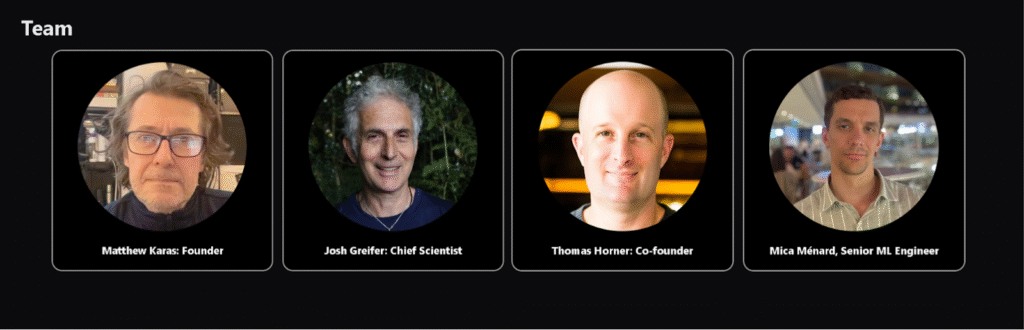
The focus on broadcast-quality reliability makes sense when you look at the founders. This isn’t a team of anonymous crypto-devs; it’s a team of veterans from media, fintech, and audio engineering.
- Matthew Karas (Founder): Former executive at Sky News, BBC, and Al Jazeera. He built the content systems for global newsrooms where “dead air” is not an option. He built content systems for global newsrooms and holds multiple patents in speech analysis and multi-modal communications
- Josh Greifer (Chief Scientist): A pioneer in low-latency audio who helped architect Steinberg Cubase and worked with BBC R&D. At Neurence, his team successfully reduced generative audio latency from 250ms to under 50ms.
- Thomas Horner (Co-founder & COO): A fintech DevOps specialist who spent 25 years building fault-tolerant trading platforms for institutions like Citibank, HSBC, and BNP Paribas. He ensures the subnet has the stability of a financial exchange.
- Mica Ménard (Senior ML Engineer): A specialist in Natural Language Processing (NLP) and a former miner at Tensora. As the team’s first hire, he built the initial working subnet in just three weeks.
The Bottom Line
With this incentive update, Babelbit is making Subnet 59 more rigorous and production-oriented. By locking 80% of the rewards behind verified, team-deployed testing, they are strengthening quality assurance and effectively turning their subnet into a production line for enterprise-grade translation software.
For miners, the message is clear: If it doesn’t run in production, it doesn’t get paid.
Website: babelbit.ai
Follow @babelbit on X
Enjoyed this article? Join our newsletter
Get the latest Bittensor & TAO ecosystem news straight to your inbox.
We respect your privacy. Unsubscribe anytime.
Be the first to comment