

For a long time, participation in the Bittensor ecosystem was largely driven by crypto-native users. Miners, validators, and early investors explored the network primarily through experimentation and community-driven discovery.
That dynamic is slowly changing.
As certain subnets mature and begin demonstrating tangible utility, institutional participants are starting to treat these networks as strategic assets rather than speculative experiments.
A recent disclosure from Astrid Intelligence PLC offers a clear example of how this shift is beginning to play out.
The company revealed that its exposure to Score (Bittensor Subnet 44) has expanded significantly following an earlier (over-the-counter) OTC investment.
While the numbers themselves are notable, they greatly highlight how institutional investors may begin accumulating positions across Bittensor’s growing subnet economy as well as show strong interest and confidence in them.
Astrid’s Initial Entry Into Score
Astrid first entered the position toward the end of 2025. On November 28, the company deployed 1,000 $TAO through an OTC partnership agreement with the Score.
At the time, the transaction was structured at a 20% discount to the prevailing $TAO market price, giving Astrid preferential entry into the subnet’s token economy.
At the moment the deal was executed:
a. 1,000 $TAO carried an approximate market value of $300,000,
b. The investment secured 78,740.05 subnet 44 ‘$ALPHA’ tokens, and
b. The implied acquisition price was 0.0127 $TAO per $ALPHA.
Within Bittensor’s subnet architecture, $ALPHA functions similarly to ownership units within the subnet economy, entitling holders to exposure to the subnet’s growth and emissions.
For Astrid, this positioned the company early within a developing AI infrastructure network.
Growth in $ALPHA Holdings
Since the original transaction, Astrid’s holdings have increased through a combination of emissions and network participation.
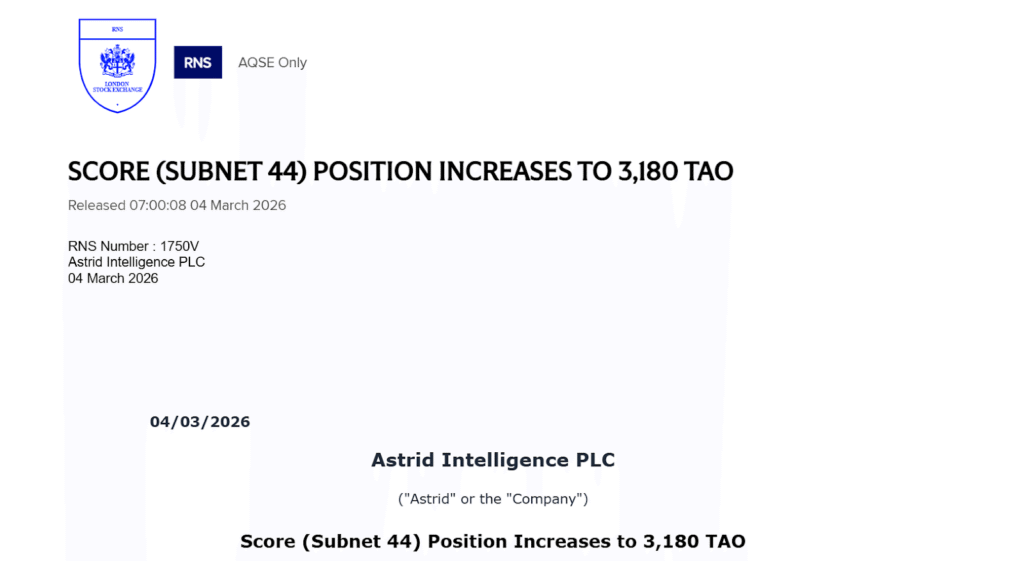
The company now reports ownership of 87,376.48 $ALPHA (Based on a current $ALPHA value of roughly 0.0364 $TAO. To give more context, that position now represents exposure equivalent to approximately 3,180 $TAO)
At today’s market valuation of about $186 per $TAO, the position implies a total value approaching $600,000.
The increase reflects two factors working simultaneously:
a. Appreciation in the price of $TAO,
b. Additional $ALPHA accumulation generated through participation in the subnet.
In other words, the position has grown not just because the asset appreciated, but because the network itself continues distributing rewards.
What Score (Bittensor Subnet 44) is Building
The subnet attracting this capital is focused on a very specific technical domain. Score (Bittensor Subnet 44) develops a real-time video intelligence infrastructure designed to power computer vision applications across distributed environments.

At the center of this effort is a platform called ‘Manako,’ a vision AI system intended to simplify how computer vision workloads are deployed and scaled. This is created with a broad objective to make it easier to interpret video streams and visual data in real-time.
This type of infrastructure has applications across several sectors:
a. Surveillance and security systems,
b. Autonomous robotics,
c. Smart cities and traffic monitoring,
d. Retail analytics and behavior tracking, and
e. Industrial safety monitoring.
Computer vision is one of the fastest growing fields in artificial intelligence, and by building the underlying infrastructure layer, the subnet is positioning itself inside a market with expanding demand.
Why Astrid Sees Subnets as Long-Term Assets
Astrid views these investments through its Astrid Accelerator initiative, a program designed to identify early-stage AI infrastructure opportunities.
Within this framework, Bittensor subnets are treated less like short-term means of accessing tokens and more like network-level equity positions.
The logic is that if a subnet successfully develops infrastructure that developers and businesses rely on, its economic layer grows alongside usage.
For investors, that creates exposure to network growth, token emissions, and underlying infrastructure adoption
Astrid’s expanding position in Score suggests the firm sees the subnet as a long-horizon investment rather than a short-term trade.
A Signal for the Broader Ecosystem
While this announcement focuses on a single subnet, it also points to a larger trend beginning to emerge inside the Bittensor ecosystem. Institutions are starting to evaluate subnets through familiar lenses:
a. Product development,
b. Infrastructure utility,
c. Token economics, and
d. Long-term adoption potential.
The networks capable of delivering real services stand to benefit most from this shift, then, capital naturally tends to follow utility.
And as Bittensor continues evolving from an experimental AI marketplace into a more structured ecosystem of specialized networks, investments like Astrid’s offer a glimpse into how institutional participants may begin allocating capital across the subnet landscape.
For now, the position in Score represents one bet among many possible opportunities, but it also highlights something increasingly clear.
The subnet economy is starting to attract attention well beyond its original crypto native audience.



Be the first to comment