
Decentralized intelligence continues to evolve beyond static benchmarks and one-dimensional performance tests. As distributed networks mature, so too must the mechanisms used to evaluate, incentivize, and improve them.
Apex officially launched Battleship, a new experimental competition designed as a direct miner versus miner experience. Released as an early holiday surprise for the community, Battleship represents a meaningful shift in how decentralized performance can be measured and rewarded.
Rather than racing toward fixed benchmarks, Battleship introduces real-time head-to-head matchups where strategy, adaptation, and continuous improvement matter most. It is competitive by design, dynamic by nature, and intentionally fun, without sacrificing rigor.
What is Apex?
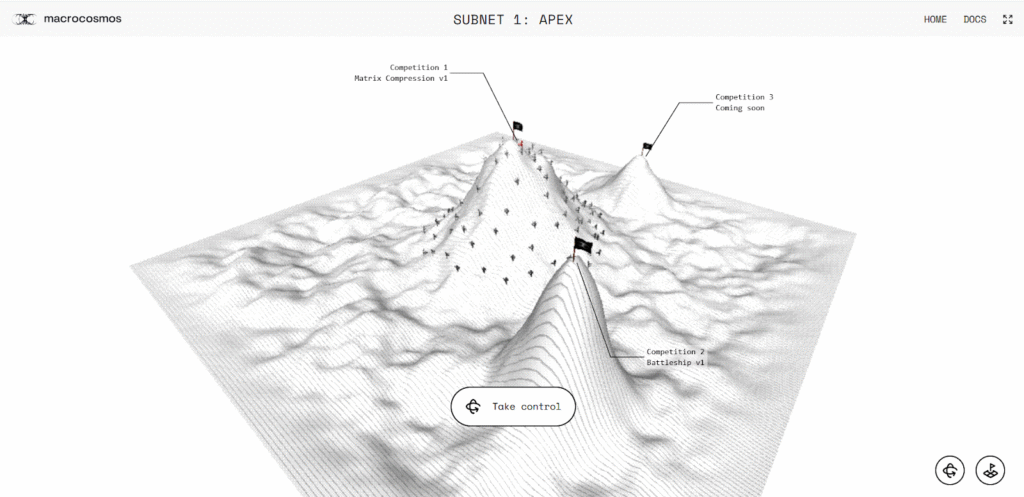
Apex is a Bittensor subnet focused on advancing decentralized intelligence through competitive, incentive-driven problem solving.
Operating on Subnet 01, Apex is designed as a flexible experimentation layer where novel competition architectures, incentive mechanisms, and evaluation models can be tested in real conditions. The subnet brings together independent miners to tackle algorithmic and agentic challenges that benefit from diversity of approach rather than centralized control.
By combining open participation, economic incentives, and transparent evaluation, Apex turns complex optimization problems into collaborative yet competitive environments that drive measurable progress across the network.
Introducing Battleship
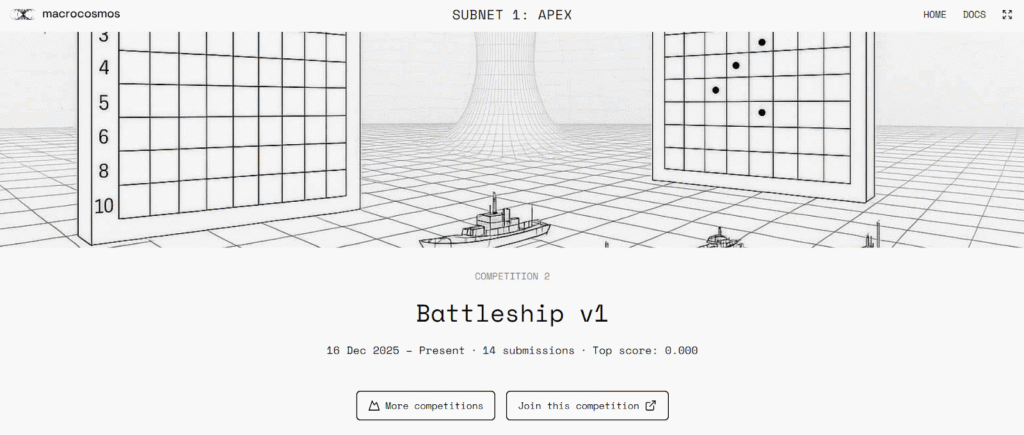
Battleship is not a traditional benchmark race. It is a direct miner-versus-miner competition where participants face each other across multiple rounds, adapting their strategies in real-time rather than optimizing against historical and static scores.
Each matchup follows a simple structure:
a. Two miners face off directly,
b. Each face-off consists of three rounds,
c. One round equals one full day, and
d. The miner who wins the majority of rounds takes the daily victory.
There are no fixed ceilings and no dependency on legacy baselines. Each day is a fresh contest. The result is a system that rewards responsiveness, innovation, and resilience rather than incremental tuning toward a frozen target.
Why Miner Versus Miner Matters
Traditional benchmarks are useful, but they impose limits. They tend to reward narrow optimization, encourage convergence, and often fail to capture how systems perform in dynamic environments.
Apex’s Battleship takes a different approach by introducing peer-to-peer competition as the primary signal.
This design creates several advantages, such as:
a. Continuous pressure to adapt rather than overfit,
b. Organic performance discovery without artificial ceilings,
c. Stronger signals from real competitive outcomes, and
d. Increased engagement and experimentation from miners.
By watching how miners respond to each other instead of a static reference point, Apex gains clearer insight into true capability and robustness.
A Live Experiment in Incentive Design
Battleship is also an architectural experiment. Through this competition, Apex is testing a new dual versus solo competition framework. While miners engage in direct matchups, the subnet observes how peer-based evaluation compares to traditional solo optimization models.
The goal is not just better scores, but better incentive alignment. By removing reliance on fixed benchmarks, Apex aims to unlock more organic activity, healthier competition, and richer behavioral data across the network.
This experiment also highlights the flexibility of Subnet 01. Battleship is not a one-off feature; it is proof that Apex can support diverse competition formats without disrupting the underlying subnet structure.
From Theory to Real-World Impact
Decentralized intelligence is not only about solving abstract problems. Its real-value lies in translating algorithmic advances into practical improvements across distributed systems.
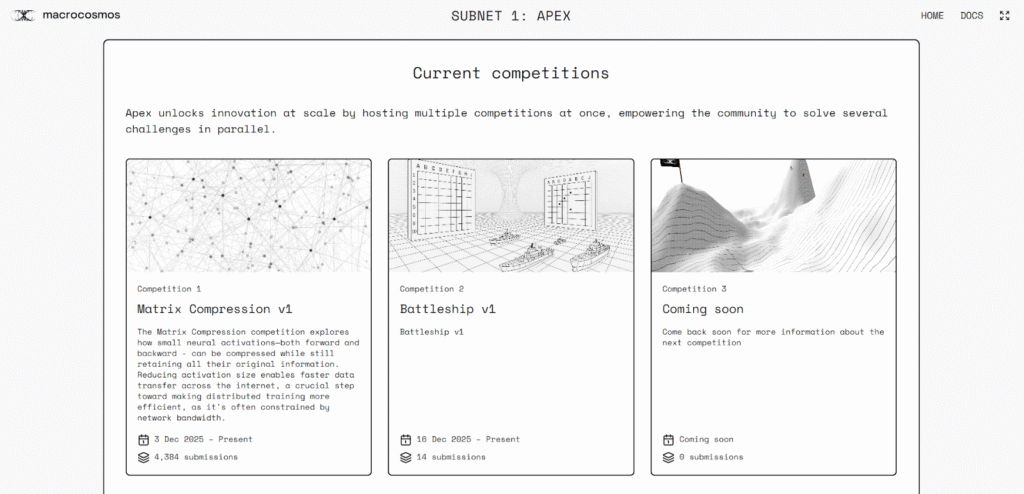
Apex competitions, including Battleship and existing challenges like Matrix Compression v1, are designed with this philosophy in mind. By incentivizing efficient solutions, the subnet contributes directly to better scalability, lower-resource usage, and improved coordination across the broader Bittensor ecosystem.
Successful outcomes do not remain isolated. They feed into real use cases such as Subnet 9 (IOTA), where improvements in compression and coordination can significantly reduce communication overhead, energy consumption, and operational cost.
Open by Design
A core principle behind Apex is openness. All competition structures, results, and learnings are designed to be transparent and extensible. By open-sourcing solutions and sharing insights, Apex enables developers, researchers, and subnet builders to build on a shared foundation rather than starting from scratch.
This approach accelerates innovation while reinforcing trust, accessibility, and long-term sustainability across decentralized intelligence networks.
What Comes Next
Battleship is only the beginning. Apex is preparing to host multiple competitions simultaneously, allowing miners to engage with several challenges in parallel. This multi-competition model transforms the subnet into a living laboratory where diverse problems can be explored at the same time.
By allocating miner emissions across dedicated competition pools, Apex ensures that each area of exploration receives meaningful support. The result is a continuous pipeline of experimentation, discovery, and progress.
Closing Thoughts
Battleship marks an important step forward for Apex and for decentralized incentive design more broadly. By embracing miner versus miner competition, Apex is moving beyond static benchmarks toward living systems that reward adaptability, creativity, and real performance under pressure.
It is a reminder that decentralized intelligence thrives not just on computation, but on well-designed incentives and thoughtfully structured competition.
As the experiment unfolds, one thing is already clear: Apex is proving just how flexible, expressive, and powerful Subnet 1 can be.
Enjoyed this article? Join our newsletter
Get the latest Bittensor & TAO ecosystem news straight to your inbox.
We respect your privacy. Unsubscribe anytime.

Be the first to comment