

Synth (Bittensor subnet 50) just launched a $20,000 hackathon built around probabilistic market intelligence. Builders get access to Synth’s predictive intelligence API and are expected to ship real tools for options, prediction markets, and equities.
Timeline
The build phase started on February 23, 2026. Submissions close March 16. Winners will be announced on March 18. That gives participants roughly three weeks to go from idea to working product. API access runs for four weeks, so teams have enough runway to build something serious instead of a weekend prototype.
What You Can Build
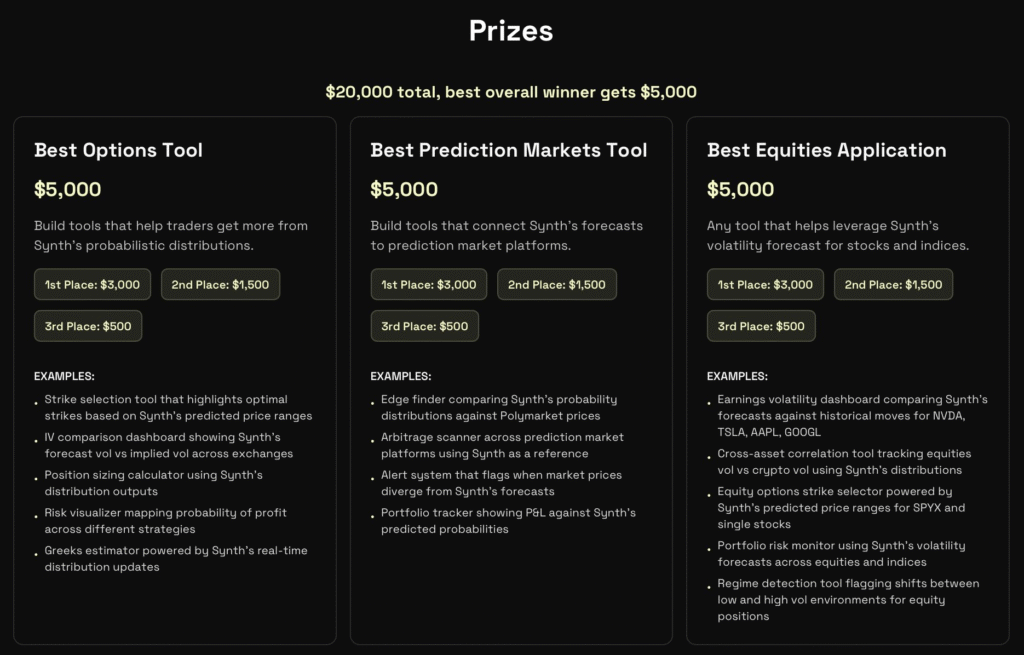
There are three main tracks, each with $5,000 in prizes (split $3,000 / $1,500 / $500):
- Options Tools — Use Synth’s probabilistic forecasts to improve pricing models, risk dashboards, volatility tools, or execution strategies.
- Prediction Markets — Build integrations that plug forecast distributions into event markets, especially around BTC and macro assets.
- Equities Applications — Develop stock analysis tools, portfolio optimizers, or systematic frameworks powered by probability distributions instead of point estimates.
On top of that, there’s a $5,000 grand prize for best overall project.
The Synth API supported access covers BTC, ETH, SOL, XAU (gold), SPY, NVDA, TSLA, AAPL, GOOGL, and other major assets.
The Judges
The panel is stacked with people who live in derivatives, prediction markets, and crypto-native capital:
- Nick Forster, CEO and Co-Founder of Derive.
- Primo Data, Head of Data at Polymarket.
- RJ from Unsupervised Capital.
- And the Synth team itself.
What You Need to Submit
Three things:
- A GitHub repo with your code.
- A demo video showing the product working.
- A one-page technical write-up explaining how you used Synth’s probabilistic data.
How to apply: Apply via here.
Judging Criteria
- Technical implementation (30%).
- Use of Synth’s probabilistic modeling (30%).
- Practical market relevance (25%).
- Innovation (15%).
In short: build something that works, uses the distributions properly, and solves a real market problem.
Enjoyed this article? Join our newsletter
Get the latest Bittensor & TAO ecosystem news straight to your inbox.
We respect your privacy. Unsubscribe anytime.



Be the first to comment