
Artificial intelligence (AI) is entering a new phase, and that’s because for more than a decade, the most powerful AI systems were controlled by a small group of large technology companies. Access to compute, data, and advanced models required enormous capital and centralized infrastructure.
But that paradigm is beginning to shift.
A growing movement is building open intelligence networks, where the creation, training, and monetization of AI can happen across decentralized systems rather than inside corporate silos.
At the center of this movement is Bittensor, a network designed to transform intelligence into an open market.
The recently released State of Bittensor Vol. 2 report by Yuma Group offers one of the most comprehensive snapshots yet of how this ecosystem is evolving.
The findings reveal something important: That decentralized AI is beginning to produce real infrastructure, real companies, and real economic value, and it’s no longer theoretical.
A Network Built for Intelligence
The report painted Bittensor as being designed to do for intelligence what the internet did for information. Just as websites became the fundamental units of the internet, subnets serve as the building blocks of Bittensor’s intelligence economy.
Each subnet is a specialized marketplace focused on a particular AI task. Participants contribute compute, data, or models, and are rewarded based on the value they produce for the network.
This structure enables a new model for funding open source AI.
Thus, instead of relying on venture capital or centralized platforms, subnet builders receive protocol-issued token (called $ALPHA) emissions that incentivize contributors to improve the system.
This becomes a strong background for a network where intelligence is:
a. Built collaboratively,
b. Evaluated through market dynamics, and
c. Monetized through open participation
In many ways, Bittensor is becoming the infrastructure layer for decentralized AI innovation.
A Message from Barry Silbert
In the report’s opening note, Barry Silbert, Founder and CEO of Yuma Group, highlights how quickly the ecosystem is maturing.
Following Bittensor’s first halving event in December 2025, the network has entered a new stage of development. What once existed primarily as a theoretical architecture is now producing real applications across several industries.
Subnets today are already powering solutions in:
a. Enterprise AI,
b. Agent-based software,
c. Forecasting markets,
d. Data infrastructure, and
e. Financial intelligence.
Silbert emphasizes that value is ‘concentrating’ in the subnets that solve real-world problems, and importantly, that value is beginning to flow back into the ecosystem through subnet ‘$ALPHA’ tokens, which now function as market signals for the usefulness of each subnet’s intelligence.
In other words, the market is beginning to determine which intelligence systems matter most.
The Subnet Economy is Expanding
One of the most notable trends highlighted in the report is the rapid growth of the subnet ‘$ALPHA’ token market. When $ALPHA were introduced in February 2025 through the Dynamic TAO (dTAO) upgrade, they created an entirely new economic layer inside the Bittensor ecosystem.
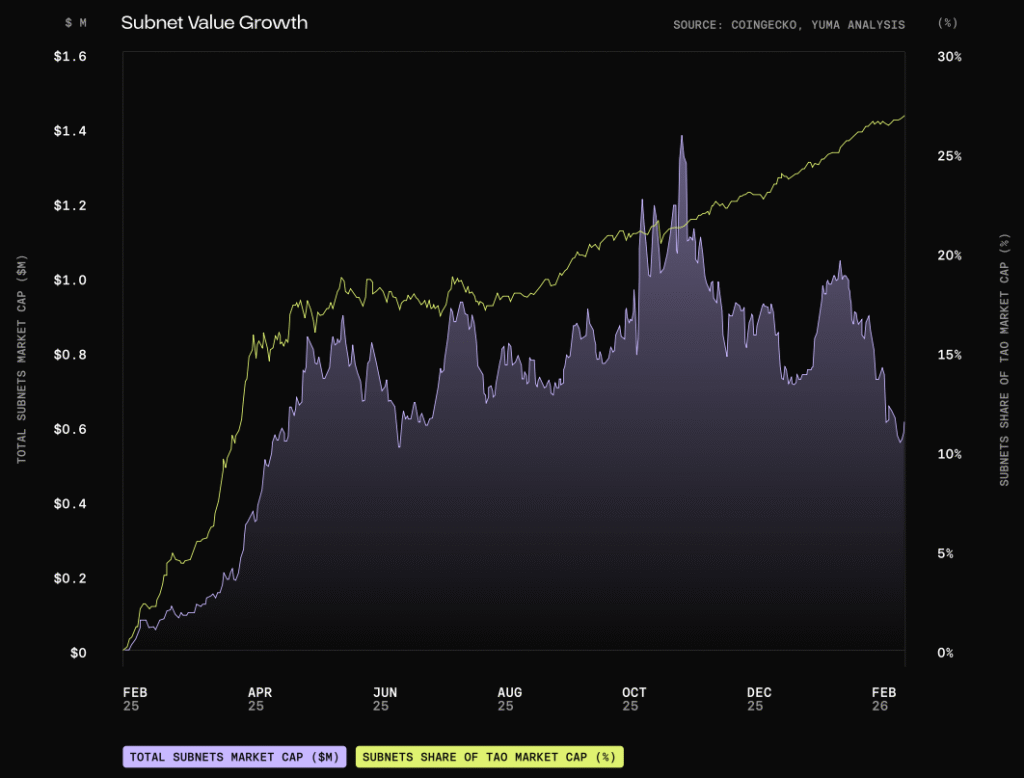
One year later, the data shows significant traction: $ALPHA now represents approximately 27% of $TAO’s market capitalization, signaling a growing share of network value moving toward the application layer.
This shift reflects an important dynamic.
Previously, most network value was captured directly by $TAO, but now, value is increasingly distributed across the individual intelligence markets represented by subnets.
As more applications emerge, the subnet economy is likely to continue expanding.
Key Metrics Behind the Growth
Several indicators show how quickly the ecosystem is evolving.
1. Subnet Market Capitalization: The combined market capitalization of $ALPHA has climbed steadily since their launch. This growth suggests that investors and network participants are beginning to view subnet tokens not simply as incentives, but as market representations of AI infrastructure value.
2. Total Subnets Price (TSP): TSP measures the cumulative price of all subnet tokens denominated in $TAO, offering a quick view into value flows between the root token ($TAO) and subnet markets.
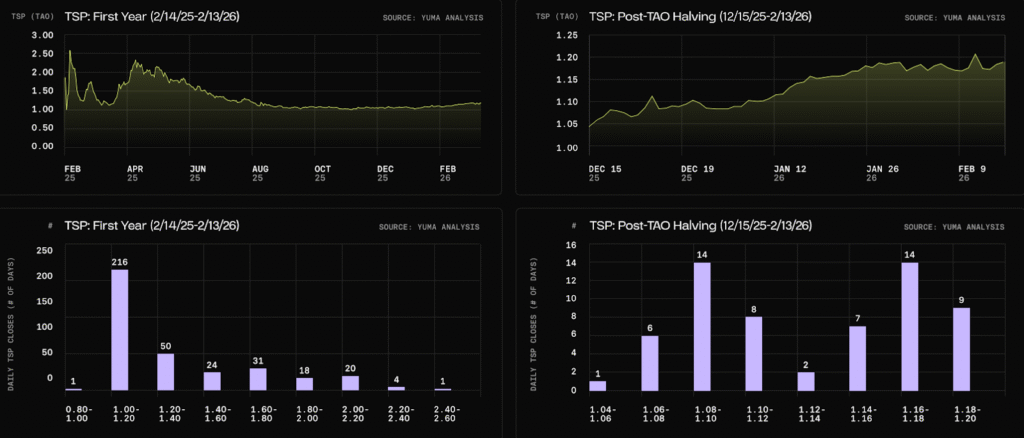
After an initial surge above 2.5 following the launch of subnet tokens, TSP stabilized around 1 before gradually recovering after the $TAO halving.
As of February 2026, TSP has risen to 1.18, suggesting renewed demand for subnet exposure.
3. Liquidity Pool Activity: Liquidity pool data also shows strong network activity. Since the halving event, the amount of $TAO locked in subnet liquidity pools has increased significantly, driven by both protocol emissions and organic trading demand.
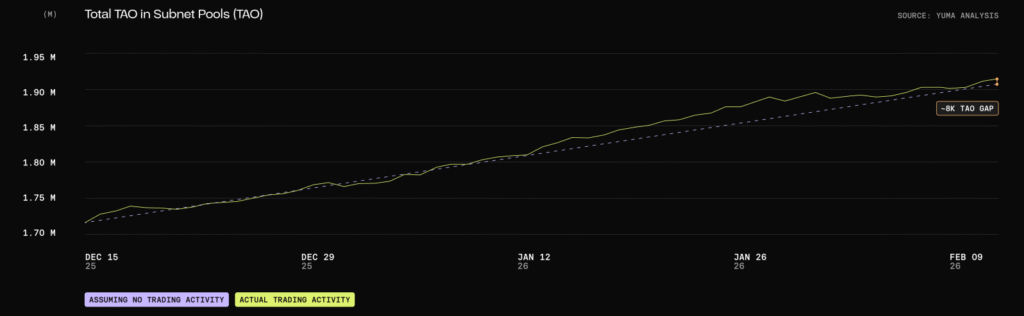
These flows play an important role in maintaining price stability and supporting the subnet token economy.
How Incentives Power the Network
Bittensor’s economic design differs fundamentally from most blockchain systems: In Bitcoin, network inflation primarily rewards miners who secure the chain, but in Bittensor, inflation is directed toward the production of intelligence.
The network distributes incentives through $ALPHAs, rewarding participants who provide valuable contributions such as:
a. GPU compute,
b. AI model training,
c. Inference services,
d. Specialized datasets, and
e. Prediction markets.
This mechanism creates a competitive environment where different subnets compete for attention, capital, and contributors.
The result is a decentralized marketplace where intelligence itself becomes a tradable resource.
Subnet Staking Rewards
Another major draw for participants is the potential yield from subnet staking. Unlike $TAO staking, which currently offers relatively modest returns,
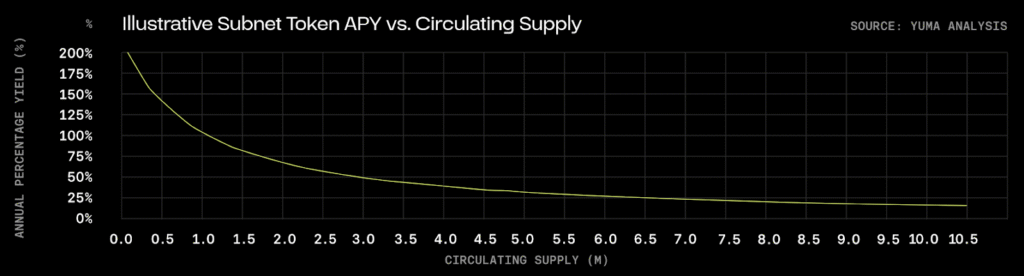
$ALPHAs can generate significantly higher annual percentage yields (APY) depending on several factors. Some of the factors are:
a. The age of the subnet,
b. The amount of circulating supply, and
c. Participation levels among contributors.
In some cases, subnet staking yields have exceeded 100% APY, though these rates fluctuate as participation grows.
The average blended reward rate across subnets is currently estimated at over 50%, making subnet exposure an attractive alternative to traditional $TAO staking.
Value is Concentrating in Leading Subnets
Despite the rapid expansion of the subnet ecosystem, value remains unevenly distributed.
Data from the report shows that the top 20% of subnets account for roughly 56% of the total subnet market value.
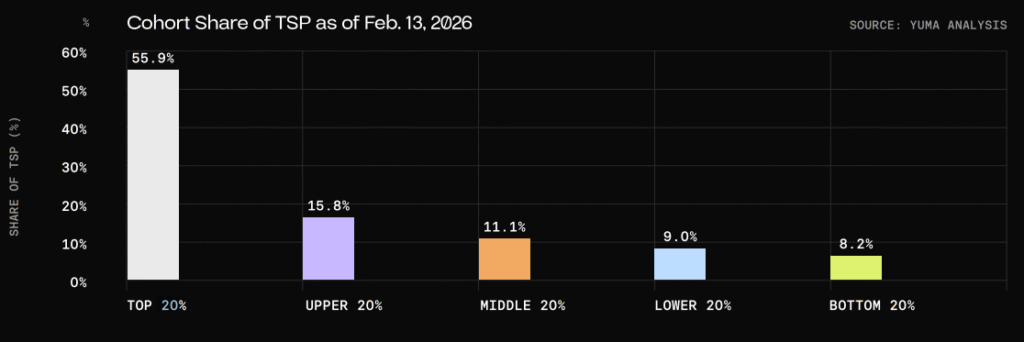
This distribution follows a typical market pattern known as the Pareto principle, where a relatively small number of projects capture the majority of value.
However, the concentration has gradually declined as newer subnets gain traction.
This suggests that the ecosystem is slowly broadening, with more projects beginning to contribute meaningful intelligence.
Real-World Applications Are Emerging
Perhaps the most exciting development is the highlight of a growing list of real-world products powered by Bittensor subnets.
Several examples illustrate how the network is already delivering practical solutions (some of them are, in fact, accelerated through Yuma Accelerator:
1. Computer Vision Intelligence
Score (Bittensor Subnet 44) processes raw video streams and converts them into structured data. It has already been deployed in sectors such as sports analytics, retail monitoring, and agricultural operations
The system can process a full football match in about two minutes for roughly $10 while maintaining 94% accuracy.
2. Agentic Software Development
Ridges (Bittensor Subnet 62) focuses on autonomous coding agents, and through it, participants compete to produce the best performing software engineering models, which can then be integrated into development tools.
The results are already approaching parity with some of the best centralized coding assistants, while delivering dramatically lower costs.
3. Financial Crime Detection
Yanez MIID (Subnet 54 on Bittensor) provides synthetic and adversarial datasets designed to help identify financial fraud. These datasets power real products such as financial crime scanners and biometric verification APIs used by enterprise clients.
By decentralizing the data pipeline, these systems can deliver services at a fraction of the cost of traditional consultants.
The Rise of Subnet Investment Vehicles
As the subnet ecosystem grows, institutional investors are beginning to seek structured exposure to the market.
The report highlighted two funds designed by Yuma Asset Management to capture this opportunity.
a. Yuma Subnet ‘Composite Fund’
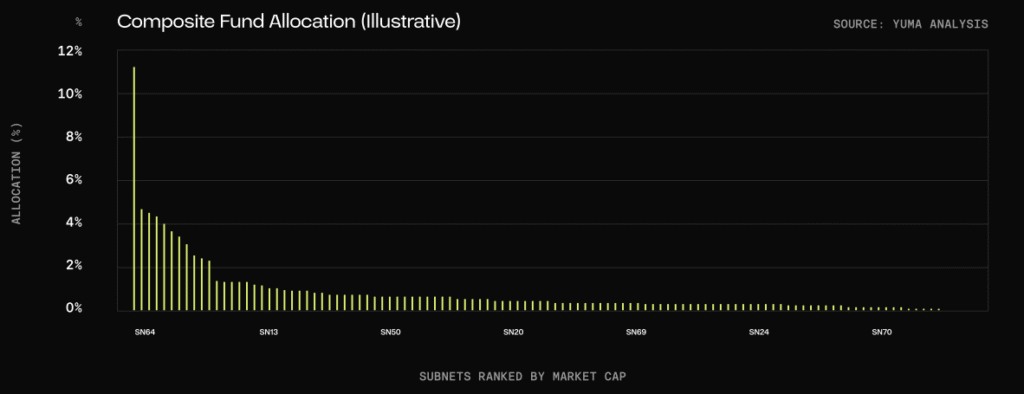
This strategy provides market-weighted exposure across the full universe of Bittensor subnets, similar to how the NASDAQ Composite tracks the broader equity market.
b. The Large Cap Subnet Fund
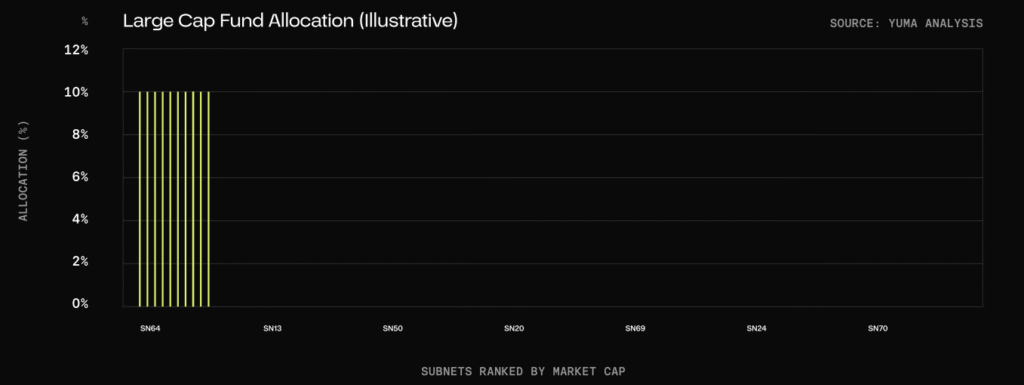
This strategy focuses specifically on the largest and most established subnets, offering a more concentrated investment profile.
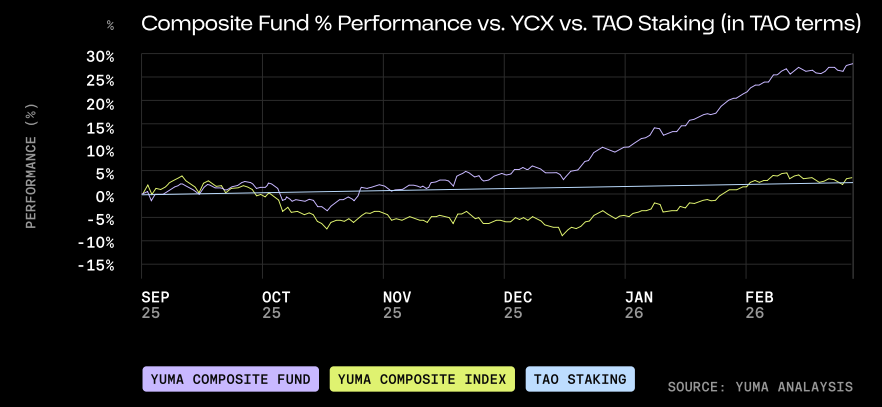
Interestingly, the Composite Fund has outperformed $TAO itself since its launch in September 2025, even during periods when the broader crypto market declined.
This performance is largely driven by $ALPHAs staking yields combined with diversified exposure.
Major Ecosystem Developments
The report also highlights several important upgrades to the Bittensor protocol.
1. TAO Flow: Introduced in November 2025, TAO Flow changed how emissions are distributed.
Instead of rewarding subnets based purely on token price, emissions now reflect the actual net flow of $TAO into each subnet, encouraging sustained participation rather than speculative trading.
2. MEV Shield: In December 2025, the network implemented MEV Shield, an encryption layer designed to prevent transaction manipulation and front running.
This feature protects participants from extractable value attacks that affect many blockchain networks.
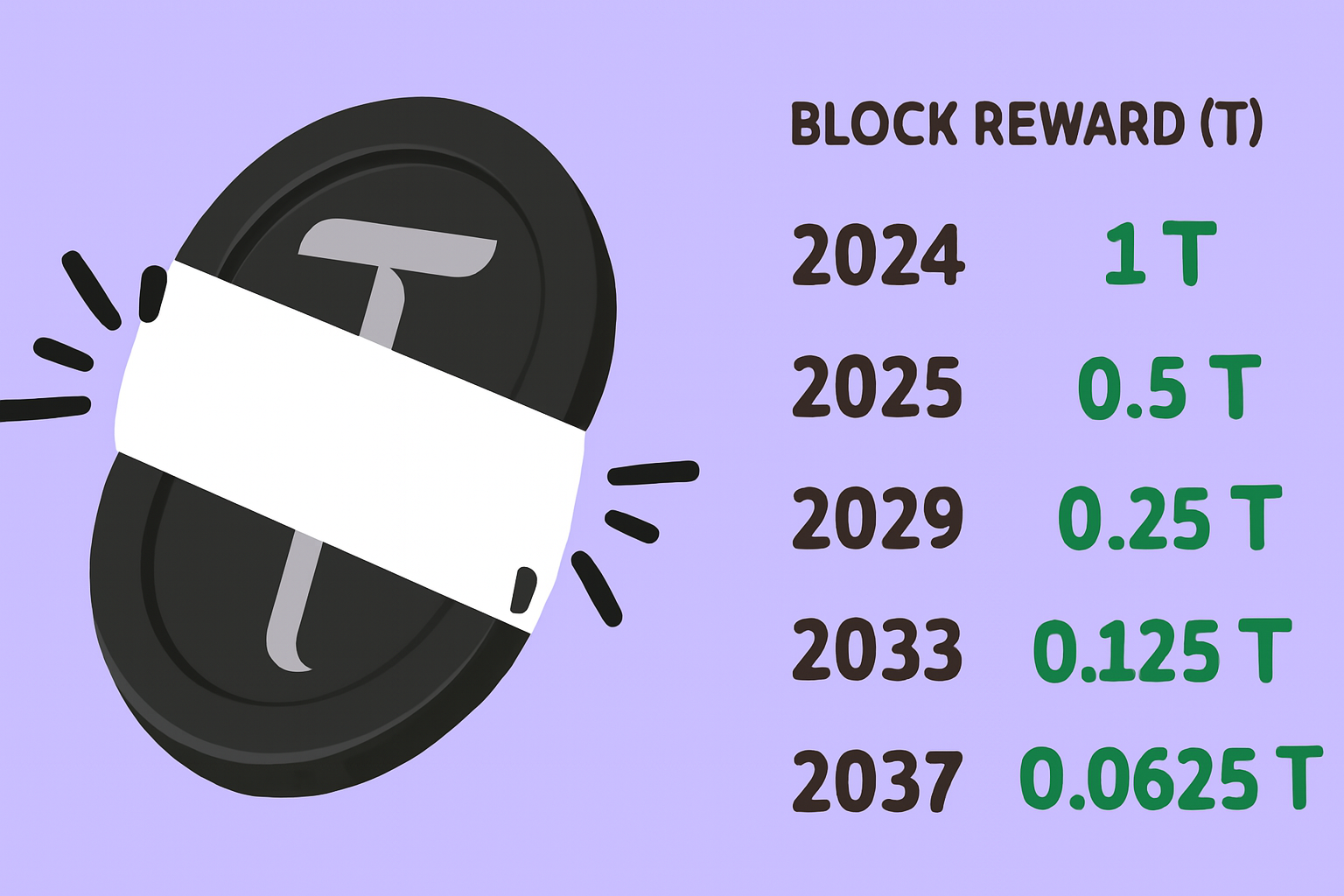
3. The First $TAO Halving Event: Also in December 2025, Bittensor experienced its first halving event, cutting daily emissions from 7,200 $TAO to 3,600 $TAO.
This milestone mirrors Bitcoin’s monetary design and marks an important step in the protocol’s long term supply schedule.
Institutional Infrastructure is Expanding
The ecosystem is also seeing rapid growth in institutional participation. Yuma’s validator infrastructure has already partnered with 12 exchanges, custodians, and wallets, expanding access to the Bittensor network.
Through these integrations:
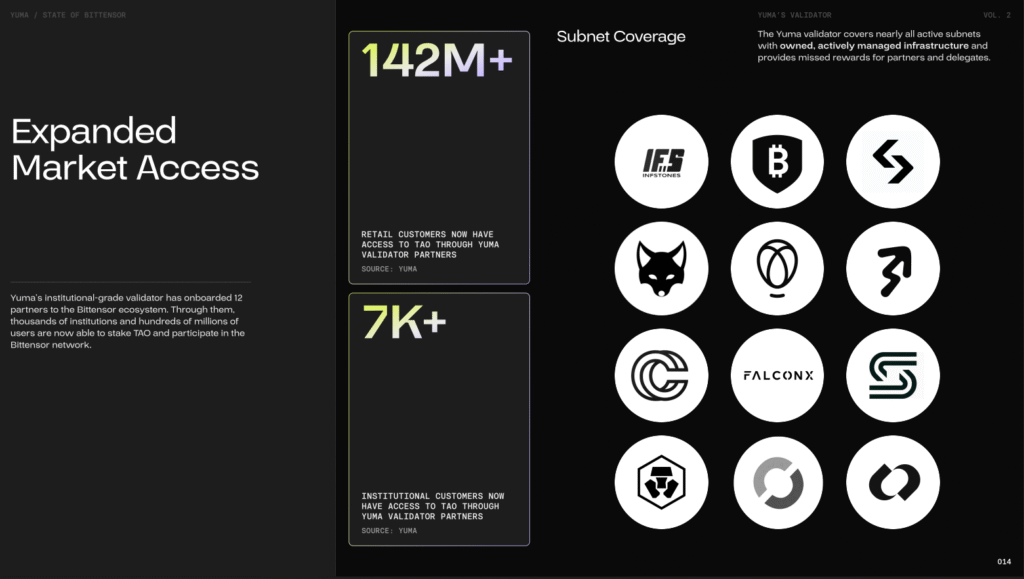
a. More than 142 million retail users can now access $TAO, and
b. Over 7,000 institutional clients have exposure to the ecosystem.
These developments represent a major step toward mainstream adoption.
The Tipping Point for Decentralized Intelligence
Taken together, the trends highlighted in the report point to a broader transformation. For years, the development of advanced AI systems required centralized resources and massive capital.
But decentralized networks like Bittensor are beginning to offer a viable alternative. Through subnet markets, token incentives, and open participation, intelligence is slowly becoming a shared infrastructure rather than a proprietary asset.
It is still early, yet the signs are increasingly clear, (crystal clear, in fact!)
Decentralized intelligence is no longer just an experiment, as it might have been perceived to be, it is evolving into a new technological and economic layer of the internet.
If current momentum continues, Bittensor may well become the foundation upon which the next generation of AI systems is built.


Be the first to comment