
DeFi on Bittensor ($TAO) is not an extension of traditional decentralized finance, it is more structural.
Instead of simply recreating exchanges, lending markets, or derivatives platforms, these subnets on Bittensor are embedding financial logic directly into an intelligence network where capital, computation, and incentives are inseparable.
What emerges is a system where capital does not just move, it actively shapes which intelligence gets funded, scaled, and sustained.
To understand where Bittensor ($TAO) is heading, you need to understand these subnets not as products, but as financial primitives for intelligence itself.
1. Vanta (Subnet 8): Trading Intelligence as a Network Output
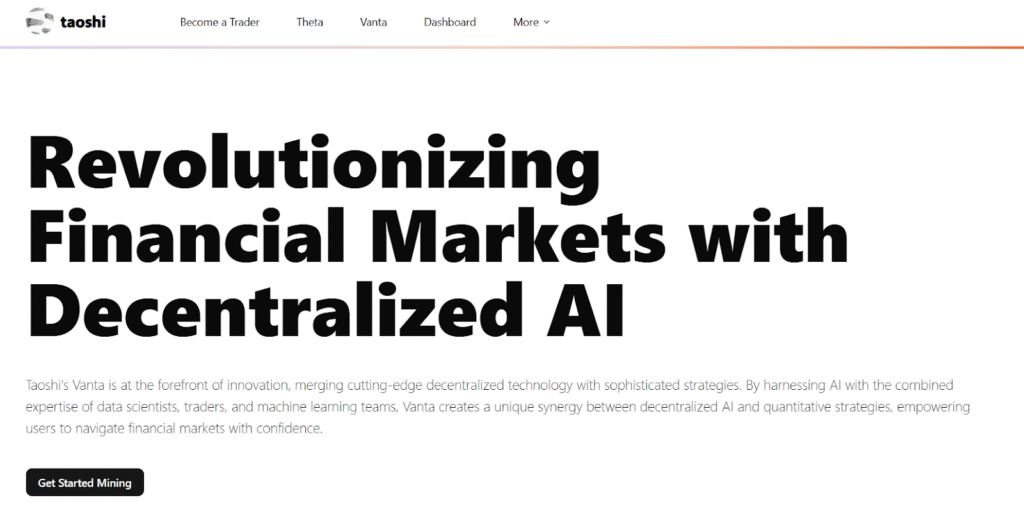
Vanta (Subnet 8) operates as a decentralized proprietary trading network where the commodity is high-quality trading intelligence. Miners submit algorithmic strategies and market predictions, while validators evaluate performance using risk-adjusted metrics such as Sharpe ratio, drawdown, and consistency over time.
Entry is gated through a 60-day on-chain challenge, ensuring only proven strategies earn ongoing rewards, with incentives dynamically adjusted based on real-time performance. The subnet aggregates top-performing strategies into a blended “super strategy,” producing a continuous stream of refined trading signals. By combining open participation with rigorous evaluation, Vanta turns global trading expertise into a composable, on-chain financial intelligence layer.
2. Astrid Bridge (Subnet 10): The Entry Point for Capital
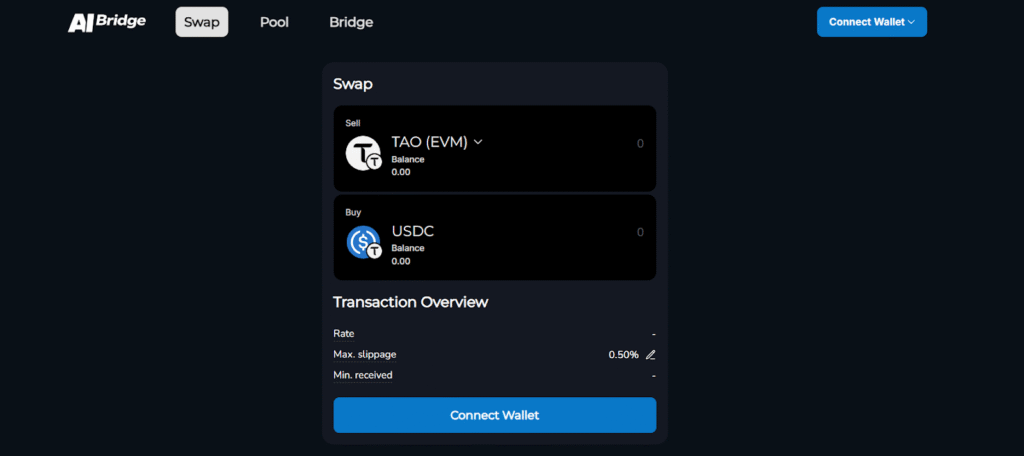
Astrid Bridge is the front door into Bittensor’s economy, solving the most important problem first: access. It abstracts away complexity and enables:
a. Cross-chain swaps from ecosystems like Ethereum and Base,
b. Seamless routing through a $TAO–$USDC liquidity layer,
c. Instant conversion into subnet ‘$ALPHA’ tokens, and
d. Automatic staking upon acquisition.
This design does two things simultaneously.
First, it removes friction. Users no longer need to understand wallets, staking flows, or subnet mechanics before participating.
Second, it ensures that capital entering the system is immediately productive, either through staking or liquidity provision.
On the backend, Subnet 10 aligns rewards with real activity. Liquidity providers are not paid for passive presence, but for enabling actual flow.
Astrid Bridge is a mechanism that turns Bittensor from a closed network into an open capital market.
3. Cartha (Subnet 35): Liquidity as a Coordinated System
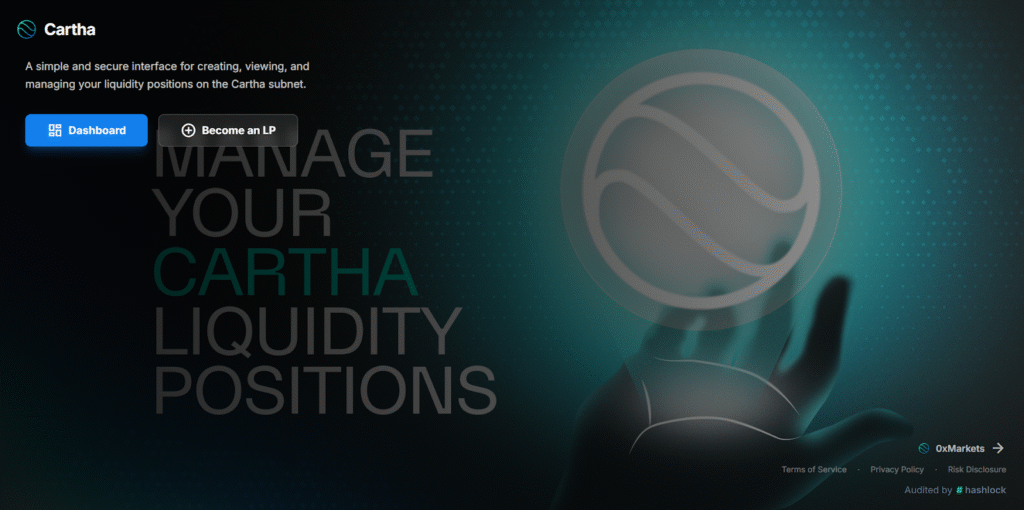
Cartha (Subnet 35) (which powers 0xMarkets) transforms Bittensor into a programmable liquidity layer. Rather than relying on fragmented pools or external market makers, it introduces structured liquidity vaults tied directly to trading demand across markets such as crypto, forex, and commodities.
Its architecture is deliberately built as:
a. Capital is deposited into market-specific vaults,
b. Liquidity is dynamically allocated based on demand,
c. Traders access high-leverage perpetual markets, and
d. Validators maintain pricing integrity and enforce liquidations.
What stands out is not leverage or market access, but coordination. Liquidity is no longer static, it moves where it is needed, when it is needed, based on real usage signals.
Incentives reinforce this system as providers earn fees and emissions, governance through $veALPHA directs future flows, and risk is managed through structured liquidation and insurance mechanisms.
Cartha positions Bittensor as a global liquidity router, where capital efficiency is continuously optimized.
4. Almanac (Subnet 41): Prediction as an Asset Class
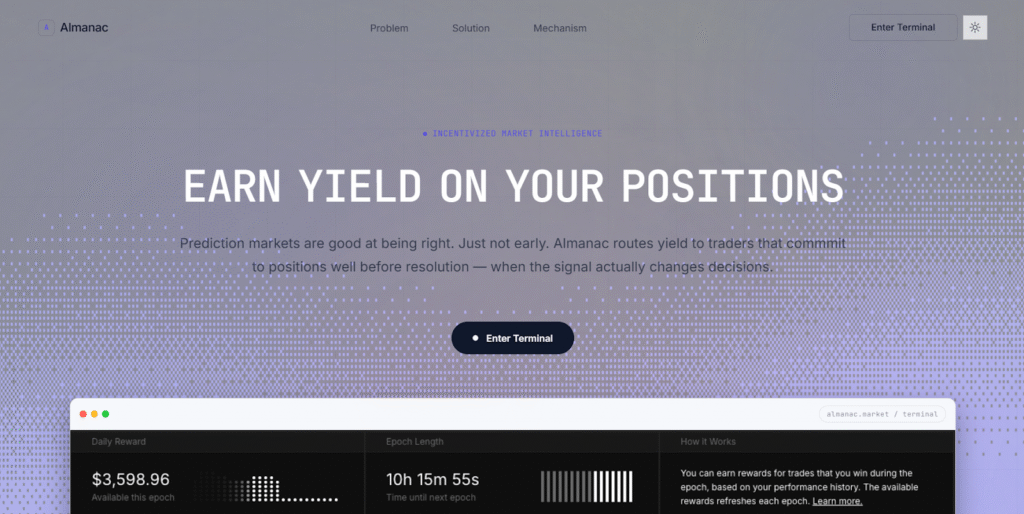
Almanac (Subnet 41) turns forecasting into a competitive, monetizable domain. Built around real-world markets, it connects on-chain incentives with external prediction platforms like Polymarket, creating a bridge between decentralized intelligence and live outcomes.
Its structure is precise:
a. Participants generate predictions through trades,
b. Performance is evaluated using ROI and consistency, and
c. Rewards flow only to those who are both accurate and repeatable.
Two design choices define its strength.
First, recency matters. Recent performance is weighted more heavily, ensuring that participants must continuously adapt.
Second, profitability is required as being active is not enough. Only correct predictions earn emissions.
Revenue from winning trades is partially recycled through buybacks, reinforcing long-term alignment.
Almanac reframes prediction as something measurable, competitive, and economically meaningful. It is a market for truth under uncertainty.
5. VoidAI (Subnet 106): Liquidity as a First-Class Commodity
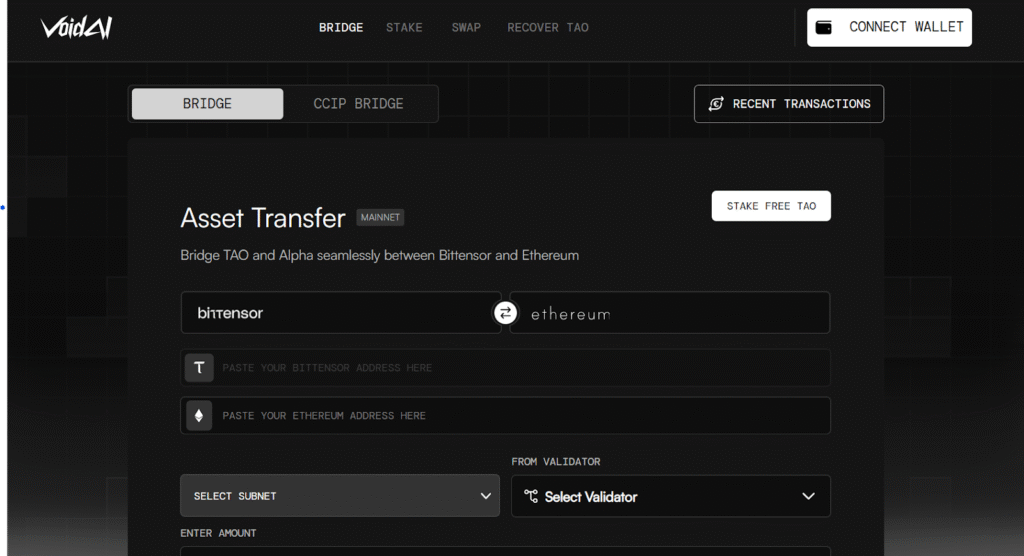
VoidAI (Subnet 106) transforms liquidity into a measurable, incentivized output by bridging Bittensor with Solana’s DeFi ecosystem. Through a cross-chain bridge and wrapped $TAO, miners provide liquidity on Solana AMMs like Raydium, stake LP tokens, and earn rewards based on verified contributions.
Validators continuously monitor liquidity size, uptime, and consistency across both chains, ensuring only sustained participation is rewarded. By aligning with Bittensor’s Dynamic TAO model, Subnet 106 replaces passive liquidity with an accountable system where depth becomes a priced and rewarded commodity. This results in a protocol-owned liquidity that extends Bittensor beyond its native environment into external markets.
Conclusion: From Financial Tools to Financial Infrastructure
Taken individually, each subnet solves a specific problem, but together, they form a coherent financial stack for intelligence.
This is not DeFi layered onto Bittensor, it is finance rebuilt around it. What emerges is a system where capital does not passively sit or speculate in isolation. It actively participates in determining which subnets grow, which signals matter, and which intelligence is worth funding.
Bittensor ($TAO) is beginning to coordinate capital around intelligence, which is a far more powerful system.
Enjoyed this article? Join our newsletter
Get the latest Bittensor & TAO ecosystem news straight to your inbox.
We respect your privacy. Unsubscribe anytime.



Be the first to comment