
Cover Image Credit: Stillcore
Every technological revolution begins in the hands of a few before it diffuses to the many. The internet started as a closed network, finance centralized around institutions, even AI (Artificial Intelligence) today sits inside a handful of frontier labs.
In its 35-pager report, The Bittensor Thesis: An Investment Framework for Decentralized Intelligence, Stillcore Capital argues that AI is now approaching the same inflection point the internet once faced. The question is no longer whether intelligence will transform the global economy. It is whether that intelligence will remain centralized or evolve into an open, market-coordinated system.
At the center of that argument sits Bittensor and its native asset, $TAO.
The Foundational Premise: Crypto Meets AI
Stillcore’s thesis rests on a structural observation:
a. Cryptocurrency solves coordination without centralized extraction,
b. AI represents the largest coordination challenge of the modern economy, and
c. Bittensor merges both.
Crypto promised minimally extractive coordination but largely devolved into speculative blockspace competition. AI, meanwhile, has centralized rapidly into well-capitalized labs.
Bittensor attempts to address both failures simultaneously by turning intelligence production itself into a market-coordinated system. Rather than coordinating money or computation alone, it coordinates machine learning output.
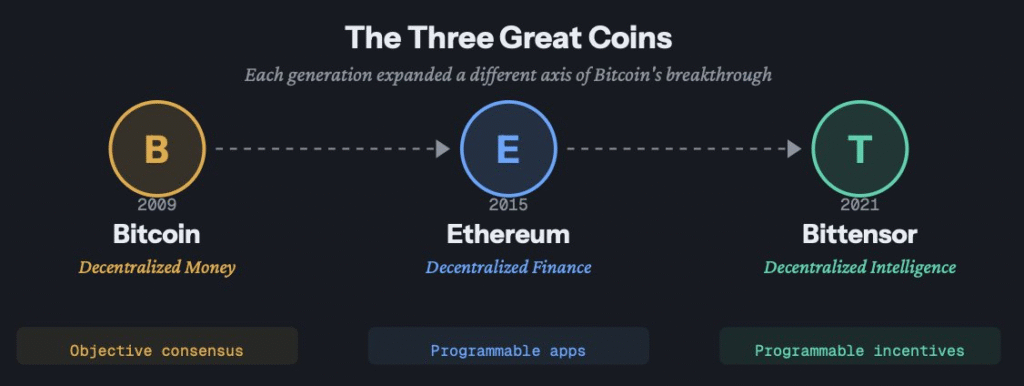
The claim is that if Bitcoin ($BTC) decentralized money and Ethereum ($ETH) decentralized finance, Bittensor ($TAO) may decentralize intelligence.
The Crypto Layer: From Tokens to Capital Allocation
Stillcore divides the crypto case into three key insights.
1. The Coordination Problem
While platforms like Uber and Amazon extract economic rent by sitting between supply and demand, crypto’s original vision was to replace extractive intermediaries with protocols.
Bitcoin proved this was possible for money, and Ethereum expanded the idea to programmable financial infrastructure.
But both coordinate relatively fixed problems as they do not dynamically spawn and fund new coordination markets.
2. The Bootstrap Mechanism
Tokens matter because they solve the capital formation problem.
A network must incentivize participants before it generates revenue. Native emissions allow a protocol to fund contributors using future network value rather than venture capital.
However, tokens only work if they accrue value as the network grows. Most projects fail because their tokens are economically optional.
Stillcore argues $TAO is structurally non-optional inside Bittensor.
3. Programmable Mining
Bittensor extends Bitcoin’s mining mechanism from hash puzzles to intelligence tasks. Instead of solving arbitrary math, miners compete to produce useful machine learning outputs.
This shift transforms mining from security maintenance into economic production.
Yuma Consensus: Decentralizing Subjective Judgment
A core technical innovation in the thesis is Yuma Consensus. Since Bitcoin’s validation is binary, a hash either meets the difficulty target or it does not.
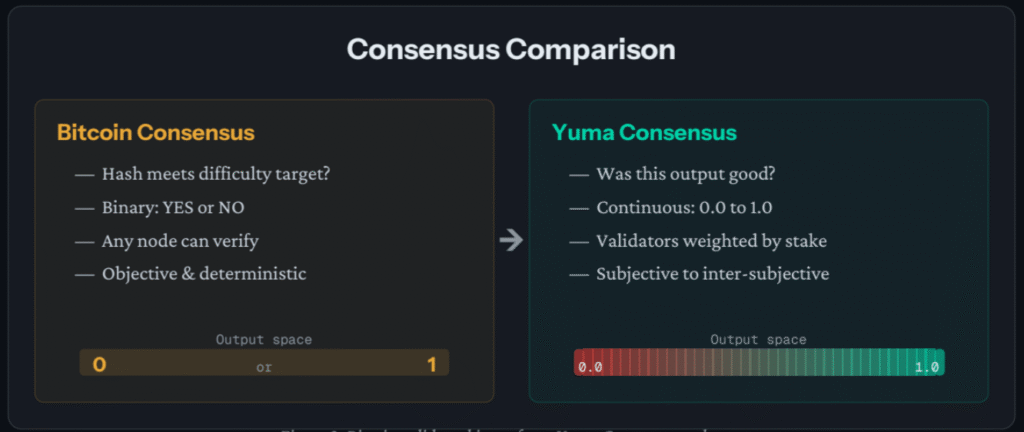
Machine learning outputs cannot be evaluated in binary form because quality exists on a gradient.
Yuma Consensus addresses this by:
a. Allowing validators to score outputs on a continuous scale,
b. Clipping outliers mathematically,
c. Weighting validators by stake, and
d. Rewarding convergence toward collective judgment.
Rather than proving an output objectively correct, the system measures statistically reliable agreement among evaluators.
This expands cryptoeconomic coordination beyond objective facts into subjective quality markets.
Subnets: The Modular Economy of Intelligence
Bittensor operates through subnets. Each subnet is effectively a specialized mining competition focused on a defined task.
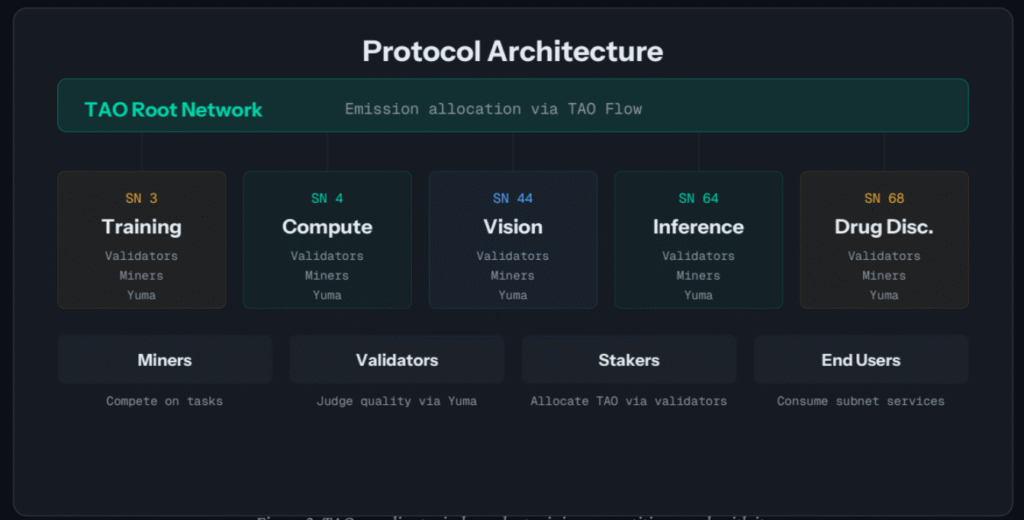
Within each subnet:
a. Miners produce outputs,
b. Validators evaluate quality,
c. Subnet ‘$ALPHA’ tokens coordinate economic participation, and
d. $TAO emissions fund the contest.
Subnets function as minimally extractive AI startups: The protocol pays contributors directly, there is no equity, no payroll, and no centralized hiring process.
Stillcore frames this as decentralized capital formation in action. Entrepreneurs can define a task, but it’s the network that funds it continuously through emissions.
TAO Flow: Market-Driven Capital Allocation
Early allocation relied on governance voting, that approach concentrated power. The system (Bittensor’s) evolved into Dynamic TAO (dTAO) and TAO Flow, replacing committee decisions with real-time market signals.
The mechanics are straightforward:
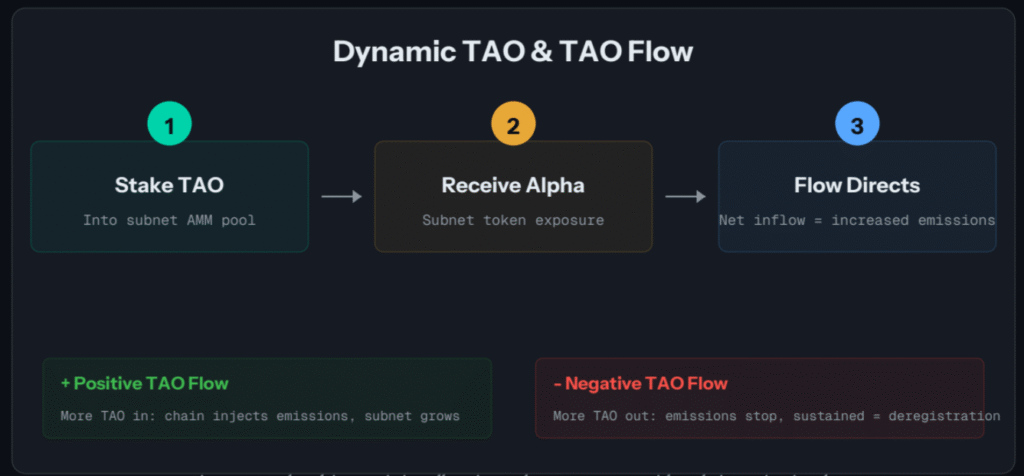
a. Each subnet has an automated market maker pairing its $ALPHA with $TAO,
b. Emissions are directed toward subnets with positive $TAO inflows, and
c. Negative net flow reduces rewards and may trigger deregistration.
Capital allocation becomes continuous and market driven, and as such, emissions follow demand.
This addresses what economists call the ‘calculation problem’. Rather than executive teams deciding where resources go, price signals guide allocation block by block.
The Flywheel: Structural Value Accrual
Stillcore describes $TAO as both ‘index’ and ‘engine.’ $TAO functions as:
a. The exclusive medium of exchange for $ALPHA,
b. The staking asset securing validation,
c. The emission base funding innovation, and
d. The index captures aggregate ecosystem value.
The causal effect of a subnet succeeding is that:
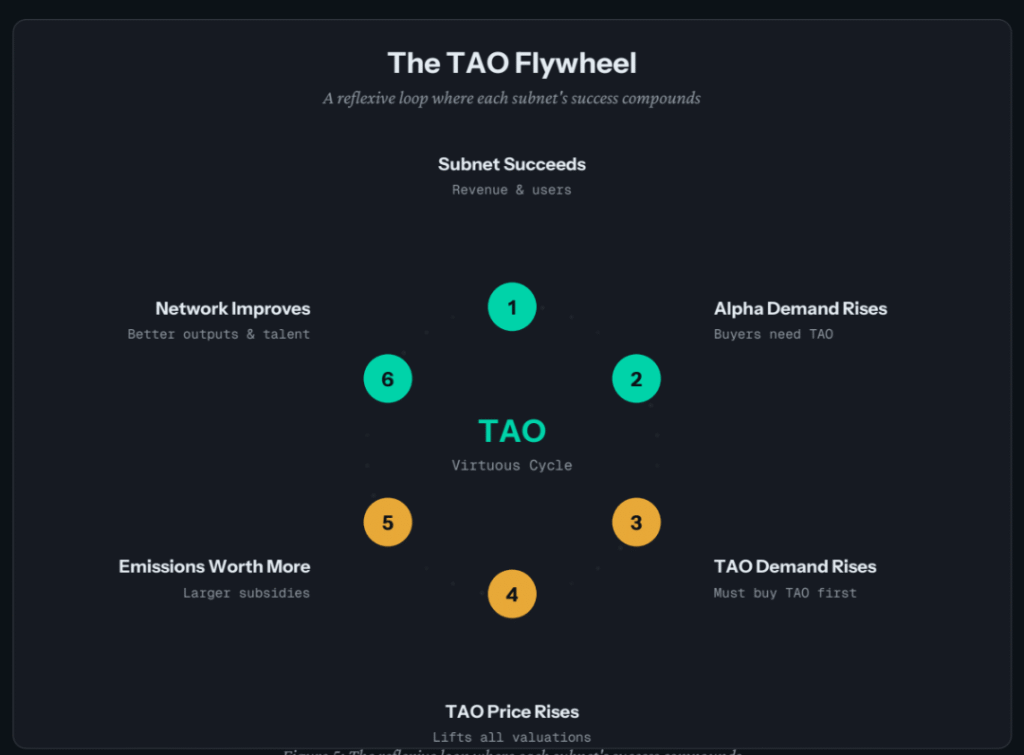
a. Demand for its $ALPHA increases,
b. Buyers must first acquire $TAO,
c. $TAO appreciates,
d. Emissions increase in dollar value,
e. More talent is attracted, and
f. Product quality improves
Each layer reinforces the next, leading to a reflexivity that is not narrative but structural.
The AI Thesis: Why Intelligence is the Right Target
Stillcore’s AI argument rests on three pillars:
1. AI Is a General Purpose Technology: AI permeates software, healthcare, logistics, robotics, finance, and beyond. Its total addressable market dwarfs decentralized finance.
2. Centralization Risk: Frontier models are controlled by a small group of labs, and training costs scale into the hundreds of millions. This recreates extractive dynamics crypto was meant to eliminate.
3. Open-Source Dynamics: Historically, TCP IP replaced proprietary networks, Linux commoditized operating systems, and Android displaced closed mobile stacks. Open systems tend to win on scale and cost.
However, open source contributors rarely capture value. Bittensor attempts to solve this by rewarding contributors with $TAO based on measurable output quality.
Evidence from Production Subnets
Stillcore does not rely solely on theory, it cites functioning subnets across:
a. Chutes (Subnet 64) for inference infrastructure,
b. Targon (Subnet 4) for confidential compute,
c. Ridges (Subnet 62) for coding agents,
d. Hippius (Subnet 75) for storage,
e. Templar (Subnet 3) for distributed training,
f. Score (Subnet 44) for computer vision, and
g. NOVA (Subnet 68) for drug discovery.
These subnets demonstrate:
a. Real-user adoption,
b. Revenue generation,
c. Significant cost advantages versus centralized providers, and
d. Peer reviewed research in decentralized training.
The revenues are modest relative to Web2 incumbents, the argument is trajectory-based rather than present scale-based.
Network Effects and Moat
Stillcore argues Bittensor’s network effects differ from typical crypto ecosystems. The moat includes:
a. Accumulated human capital,
b. Deep $TAO denominated liquidity,
c. Continuous emission funding,
d. Fair launch distribution, and
e. Cross subnet composability.
Launching a competing ecosystem would require replicating years of emissions, liquidity, and integrated infrastructure.
The code can be forked, and the economic flywheel cannot easily be cloned.
The Decentralized Frontier Lab
Taken together, subnets form and deliver a vertically integrated AI stack:
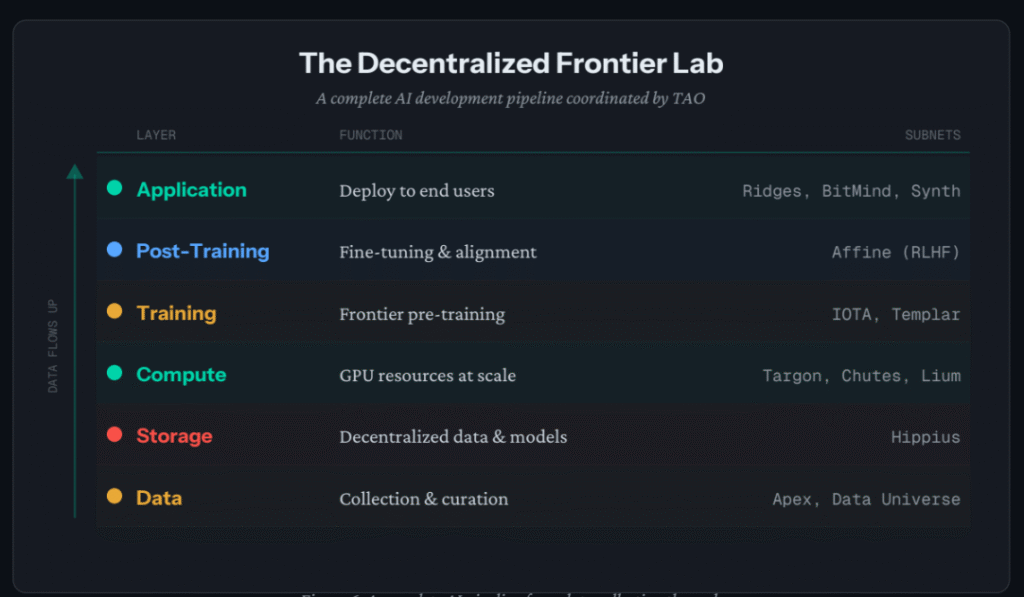
a. Data,
b. Storage,
c. Compute,
d. Training,
e. Post-training refinement, and
f. Application deployment.
No central entity controls it but it functions cohesively through shared $TAO economics. Stillcore describes this as a decentralized frontier lab coordinated by markets rather than executives.
The Asymmetric Bet
Stillcore’s thesis ultimately makes a directional claim. It opines that if AI becomes the defining economic transformation of the century, open source commoditizes frontier intelligence, and market coordination outperforms centralized capital allocation, then, Bittensor represents a structurally asymmetric opportunity.
The argument has never been that Bittensor will replace all centralized AI labs, it is that decentralized intelligence may capture meaningful share in a market large enough that even partial penetration yields outsized returns.
Bitcoin decentralized money, Ethereum does with finance, and Bittensor is attempting to do it with intelligence.
Stillcore’s report frames $TAO not as another crypto asset competing for attention, but as a coordination layer for the most important technological shift of the era.
Whether that thesis proves correct will depend on execution, adoption, and the durability of its economic design. But as presented, it is one of the most comprehensive structural arguments yet made for decentralized AI as an investable category.



Be the first to comment