

A model doesn’t always need billions of new parameters or another expensive training run to become better. Sometimes, the biggest gains come from understanding where it fails and changing only the parts responsible for those failures.
That is the idea behind Axonry (SN99), a subnet that turns AI model improvement into a competitive process where miners use AI agents to identify weaknesses, make targeted changes to model weights, and compete to produce the strongest version of a shared model.
Instead of relying on a single team to decide how a model improves, Axonry opens the process to competing approaches, with successful edits earning subnet rewards and becoming part of a growing model lineage.
What Is Axonry?

Axonry is a subnet focused on Weight-Space Programming (WSP), a method of directly editing a language model’s weights to change how it behaves.
Traditional fine-tuning typically involves training a model on additional data, updating its parameters through optimization, and spending significant compute on the process.
Axonry explores a different approach where AI agents investigate the model’s internal structure, identify the weights associated with a specific weakness, and produce small, targeted edits.
These edits can change how a model reasons or responds without adding more parameters or running a conventional gradient-based training process.
The idea builds on research from MIT CSAIL’s Sparks of Weight-Space Programming, which demonstrated that carefully editing a very small portion of a model’s weights could produce substantial improvements in reasoning performance.
Axonry takes this approach beyond a single research experiment by turning it into an ongoing competition.
How Axonry Works
Axonry uses a competitive system in which miners submit weight-editing methods, AI agents execute them, and the resulting models are evaluated against the current champion.
The process works as follows:
1) Identify a weakness: Miners develop methods that help an AI agent find areas where the current model underperforms using practice data.
2) Produce a targeted edit: The agent investigates the model’s internal structure, localizes the relevant weights, and derives a small declarative weight patch (ΔW) designed to improve its behaviour.
3) Commit and submit: The miner commits a hash of their entry on-chain using Bittensor’s set_commitment mechanism, establishing priority, then submits the entry through the competition’s GitHub repository for review.
4) Execute in a sandbox: Approved entries run on dedicated GPU hardware in a fresh environment. Each agent’s execution is isolated, and its sandbox is destroyed after the run.
5) Benchmark against the champion: Axonry rebuilds the model with the proposed edit and tests it against the existing champion using the same benchmark items and seeds.
6) Earn the champion position: A new edit replaces the champion only if it stays within the allowed regression tolerance across benchmarks and shows clear improvement on at least two of them. The winning model becomes the new benchmark for subsequent competitors.
This gives miners a clear objective: to produce an improvement that can survive testing across multiple benchmarks, not just optimize for one score.
The Architecture Behind the Competition
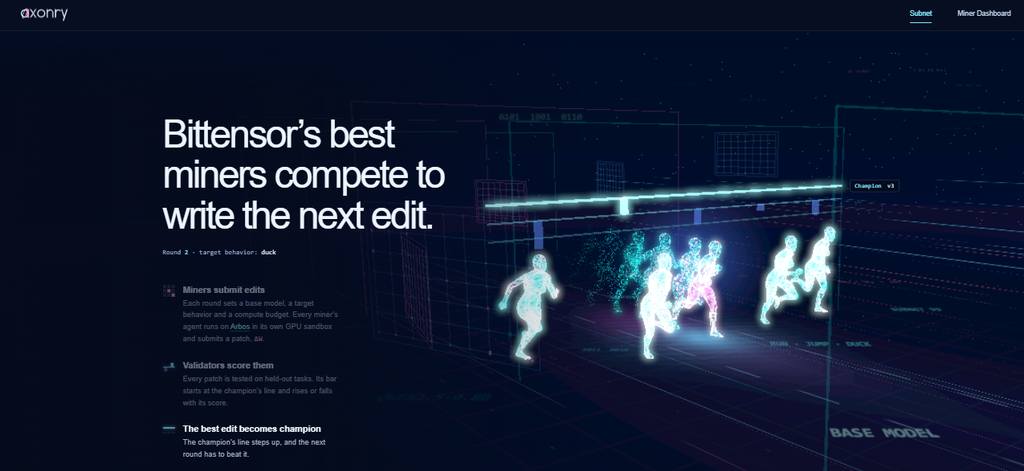
Axonry is built around a few components that keep the competition reproducible and the results publicly inspectable.
1) Weight-space editing toolkit: The WeightSpaceProgramming repository provides the competition framework and tools for submitting weight-editing methods.
2) Agent execution and GPU infrastructure: Agents run on dedicated hardware through the execution setup, with Arbos providing GPU and agent-sandbox infrastructure.
3) Commitment and review system: Entries are committed on-chain and reviewed for novelty, feasibility, and compliance. Methods cannot use benchmark leakage, external model weights, or trivial duplicate submissions.
4) Standardized evaluation: Proposed edits are tested under controlled conditions against the current champion. Rules, practice data, GPU budgets, evaluation thresholds, and fees are published.
5) Public results and model lineage: Successful edits, scores, agent runs, and resulting weights are published, allowing people to inspect the competition and see how the champion has evolved.
Because edits can build on previous winning edits, the competition can accumulate improvements over time. A miner doesn’t necessarily have to start from the original model; they can work on the current champion and try to push it further.
Why Axonry’s Approach Is Interesting
The appeal is the scale of improvement Axonry has reported without growing the model.
The underlying MIT research showed that editing approximately 0.016% of the weights in Qwen3.5-0.8B raised its MATH-500 score from 7.9% to 48.1%, with gains also reported on GSM8K and IFEval.
Axonry has continued that line of work through its competitive champion system, where miners build on previous edits and improve the same model over successive rounds.
This is important because model improvement is often associated with larger models, more training data, and expensive compute. Axonry is exploring how much performance can be unlocked by changing the right parts of a model, with agents doing the investigation and competing to find effective edits.
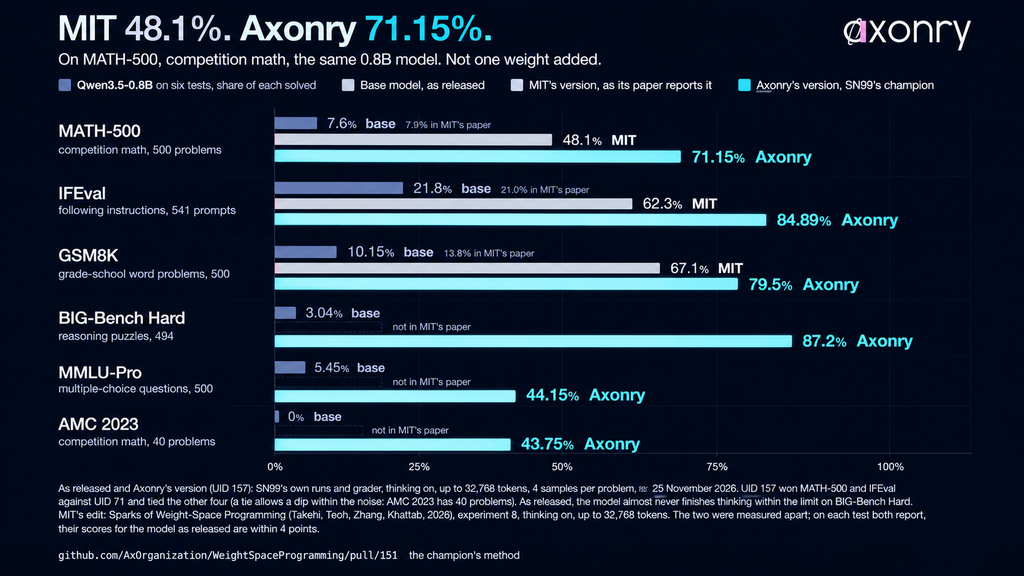
Its results so far are notable:
1) MATH-500: The champion lineage has reportedly reached 71.15%, up from the 7.9% baseline, through successive weight edits.
2) AMC 2023: The model reportedly improved from 0% to 43.75% on the 40-problem evaluation.
3) GSM8K: MIT’s version scored ~67.1%; the Axonry champion lineage reached 78.95% (with later evaluations higher).
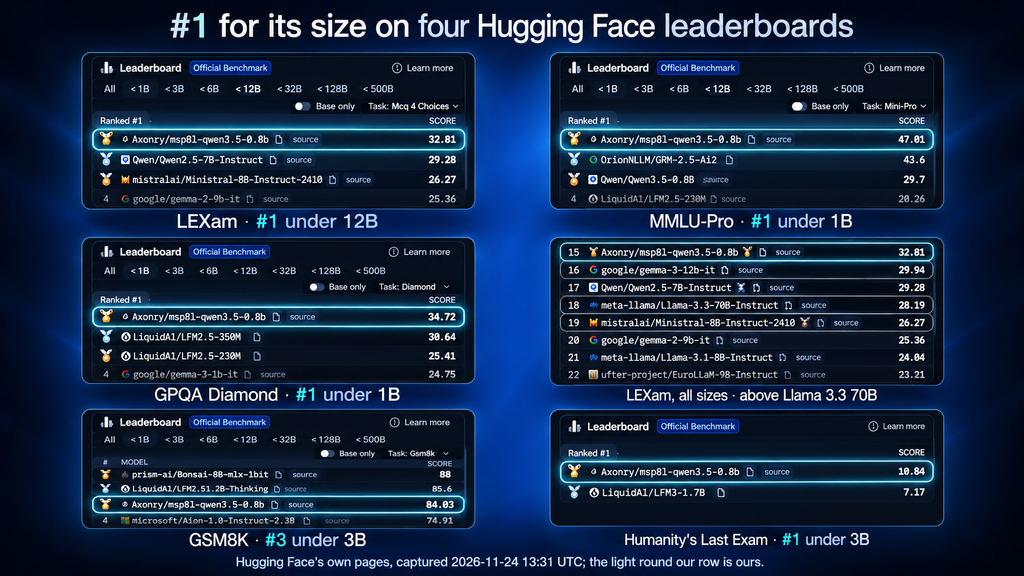
4) Humanity’s Last Exam: Axonry’s 0.8B model reportedly scored 10.84%, compared with 5.68% for Meta’s Llama 4 Maverick 402B on the referenced leaderboard and took first place in its size class on several official boards.
These are reported results, not independent guarantees of performance across every task. However, they show why the subnet is gaining attention.
➡ For more on Axonry’s earlier milestones, see The TAO Daily coverage, HERE
How Miners and Validators Participate
Axonry has separate roles for miners and validators.
a) Miners: Develop the methods that improve the model. They register a hotkey, prepare their editing approach, commit and submit an entry, and fund the costs of agent execution, GPU usage, and review through alpha transfers to the subnet treasury.
Each registered hotkey is limited to one entry, with the first commitment counting.
The miner tooling is available through the Axonry GitHub repository, which includes the setup and submission instructions.
b) Validators: Do not perform the benchmark scoring themselves. They verify the owner-signed published weights, check registration and staleness, and set the weights on-chain. Standard Bittensor validator requirements, including stake and permit rules, apply.
The subnet has 256 competitive UID slots, and its tempo is approximately 360 blocks. Its emissions are divided between miners, validators, and the owner, with the exact proportions subject to change.
How to Access Axonry
Axonry is an open competition, and there are several ways to engage with it:
1) Explore the project: Visit the official Axonry website to follow the subnet and its progress.
2) Inspect the code: Browse the main repository and the weight-space programming competition toolkit.
3) Try the model: The public Qwen3.5-derived 0.8B checkpoint is available under Apache-2.0.
4) Become a miner: Register a hotkey, prepare a novel weight-editing method, and follow the commitment and PR submission workflow in the repository.
5) Become a validator: Set up a validator using the published instructions, meet subnet and network requirements, and validate the owner-signed weights.
6) Follow the competition: Keep an eye on the SN99 subnet page and Axonry’s X account for champion changes, benchmark progress, and new entries.
The Bigger Picture

Axonry is building a system where model improvements don’t have to come from a closed research team or a single training pipeline. Anyone with a strong method can compete to improve the same model, while the results, edits, and winning lineage remain open to inspection.
Its early benchmark results give the idea credibility, but the more interesting part is the competition itself. Each successful edit gives the next miner a stronger starting point, allowing improvements to stack as the model evolves.
If Axonry can keep delivering measurable gains while maintaining its open evaluation process, it could turn weight-space programming from a promising research technique into a practical way to improve AI models through continuous competition.
➡ See our earlier coverage on how Bittensor subnets create real AI value, HERE
Enjoyed this article? Join our newsletter
Get the latest TAO & Bittensor news straight to your inbox.
We respect your privacy. Unsubscribe anytime.
Enjoyed this article?
Join our newsletter
Get the latest TAO & Bittensor news straight to your inbox — every morning before markets open.


No comments yet — be the first.