


Liquidity in Bittensor’s ten deepest subnet pools rose 196% between June 2025 and September 2026, while trading volume fell 61%.
That divergence led Yuma Group to ask how much liquidity subnet pools need under Dynamic TAO (dTAO).
Two November 2026 papers, building on a presentation at the Exploit Summit in Montreal, explore a mechanism called Alpha Subnet Market Reloaded (ASMR).
1. Part 1 examines excess liquidity, compares four pool designs, and simulates a one-time reduction in reserves.
2. Part 2 models daily reserve adjustments and compares three ways to allocate the TAO they release.
Deeper pools make large trades easier to execute. Yuma argues that beyond a certain point, extra depth can also make Alpha prices slower to reflect changes in demand.
The two papers examine where that trade-off begins and how it might vary across subnets.
The Core Problem of Excess Liquidity
On September 30, 2026, subnet pools held 1.97 million TAO, equivalent to 61% of all TAO emitted since dTAO launched.
Daily volatility in the Yuma Composite Index (YCX), an index that captures price movements across the dTAO ecosystem on a market-cap-weighted basis, fell from 2.07% to 0.64% over the period studied.
Yuma illustrates what deeper reserves could mean for Chutes (SN64).
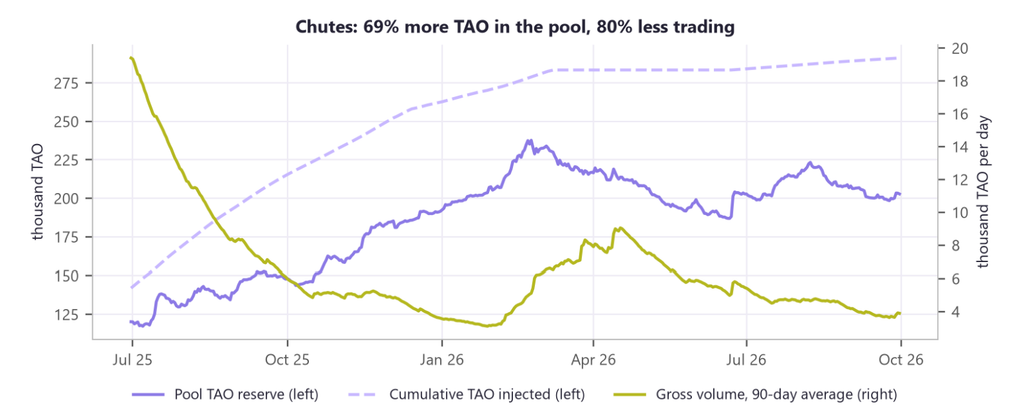
A 100,000 TAO buy would have lifted its Alpha price by 123% at the September 30 starting point, versus 103% two years later if reserves kept growing.
Yuma argues that a weaker price response can dampen the signal that connects demand to miner rewards and gives miners an incentive to expand capacity.
A major source of that depth was emissions entering pools as TAO paired with newly created Alpha.
Historically, about 85% of emissions went into pools this way, compared with roughly 31% in the most recent period studied.
In a one-time simulation, Yuma retired about 98 million Alpha created through those injections. The YCX rose to 2.3 times its starting level, showing how sensitive modeled prices were to the initial reserve balances.
The Thesis Shared Across Both Papers
Yuma proposes sizing pools around the trades they actually handle. Its measure is slippage, the gap between the quoted price and the average execution price.
A pool may need more depth if typical trades routinely push execution prices beyond the target.
Pool design also determines how efficiently those reserves support trading. Part 1 compares four designs, including a super-elliptic curve that applies one pricing rule to buys and sells and sets finite reserve boundaries at 21 million.
The curve governs how trades are priced and settled, while ASMR adjusts reserve levels as trading activity changes.
How ASMR’s Continuous Feedback Loop Works
Part 2 models a daily process that uses trading activity to determine when and how quickly to reduce reserves.
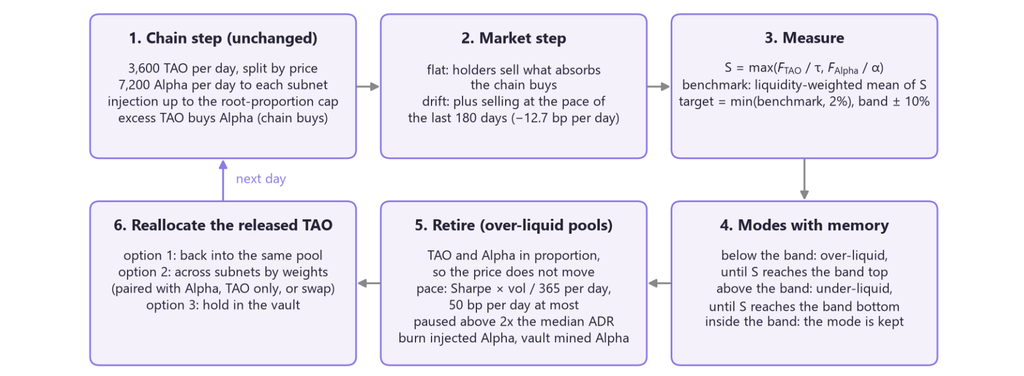
1. Estimate Slippage: Use 90 days of average daily net market flows, excluding protocol activity, and calculate slippage on the side of the pool where it would be greater. Set the target at the lower of the network’s liquidity-weighted average slippage or 2%, with a tolerance band of 10% on either side.
2. Change a Pool’s Status Only When It Crosses the Opposite Edge of the Band: This prevents small moves around the target from repeatedly switching it between excess and insufficient liquidity.
3. Withdraw TAO and Alpha in Equal Proportions: This preserves the price at the point of withdrawal. Burn protocol-injected Alpha up to the ownership limit, vault excess mined Alpha, and hold the released TAO temporarily.
4. Cap the Pace of Adjustment: Set it using each pool’s volatility multiplied by a Sharpe parameter of 1.5 in the base case, with a hard ceiling of 50 basis points of daily price impact.
5. Pause Alpha Removal When External Stake Is High: The ADR guard kicks in when externally staked Alpha relative to pool Alpha exceeds twice the network median. Removal can resume below 1.5 times the median.
6. Allocate the Released TAO: Return it to the originating pool, redistribute it across subnets by weight, or keep it in a protocol vault.
The process repeats daily because higher Alpha prices can direct more of the next day’s emissions into paired reserves, rebuilding some of the depth just removed.
Simulation Results From Part 2
Yuma simulated two years across 128 subnets, using the September 30, 2026 chain state and testing both flat markets and persistent selling.
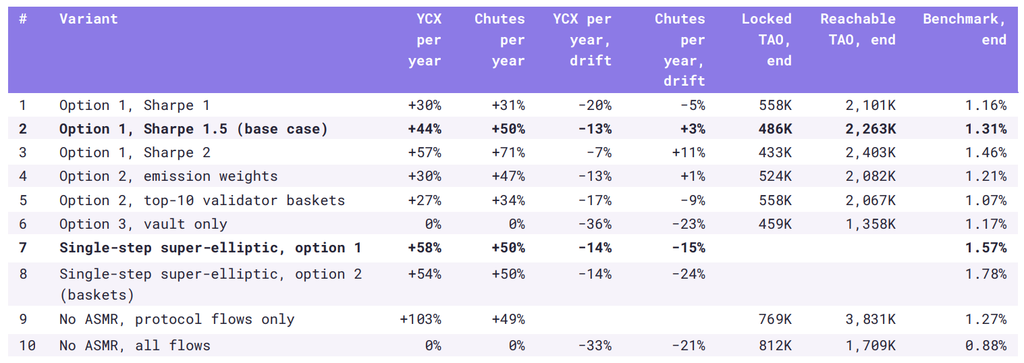
1. Flat Market: Returning released TAO to its originating pool lifted the YCX 44% per year and Chutes 50% at the base pace. Faster and slower adjustments lifted the YCX 57% and 30%, respectively.
Weighted redistribution produced gains of 27% to 30%. The index stayed flat when TAO remained in the vault and when ASMR was absent. Without ASMR, benchmark slippage fell to 0.88% as reserves accumulated.
2. Persistent Selling: The YCX fell 33% per year without ASMR. Returning TAO to its originating pool narrowed the annual decline to 13%, while keeping it in the vault deepened it to 36%.
After two years, the same 100,000 TAO buy moved the price roughly twice as much under the base ASMR case as it did when reserves kept accumulating.
Open Questions and Next Steps
The papers identify four design choices that need further testing.
1. Liquidity Targets: Check whether the 90-day window, 2% cap, and tolerance band suit subnets with different trading patterns.
2. Pacing and Safeguards: Test how the adjustment rate and ADR guard behave under stress, and whether block-level averaging or aggregate caps would make the mechanism harder to manipulate.
3. TAO Allocation: Assess which approach works best across different market conditions.
4. Settlement Design: Test how the proposed curves behave as pools approach their reserve limits.
Yuma identifies block-level simulation as the next step for testing what happens when large trades cluster and liquidity shifts within a day.
It invites independent researchers and agents to challenge the assumptions before the community considers a formal protocol proposal.
➛ Review Yuma’s Part 1 and Part 2 Research on ASMR.
Enjoyed this article? Join our newsletter
Get the latest TAO & Bittensor news straight to your inbox.
We respect your privacy. Unsubscribe anytime.
Enjoyed this article?
Join our newsletter
Get the latest TAO & Bittensor news straight to your inbox — every morning before markets open.


No comments yet — be the first.