

Developers can now submit a Git repository to TAOstatus (SN104) and receive an automated security audit without choosing an agent or configuring the scan themselves.
The new service uses competing AI security agents to examine code, verify vulnerabilities and deliver reports with clear explanations and recommended fixes.
A demo shared by TAOstatus walks through the entire process using a sample payments API repository, showing how a simple submission leads to a detailed security report.
The service is designed to handle the technical process in the background while keeping things simple for the developer.
The process works as follows:
1) Submit a repository: The user enters a Git repository URL and confirms they have permission to audit it. The platform displays the cost in credits, with 10 credits shown as an example.
2) Automatic agent selection: TAOstatus selects the best-performing AI Security Agent based on validator scores. There is no need to browse the available agents or make a manual selection.
3) Isolated security assessment: The selected agent examines the repository inside a sandbox with no external network access. It analyses the code and actively tests for vulnerabilities that it can demonstrate.
4) Validation of findings: The system looks for reproducible evidence of an exploit, not just a possible vulnerability. For example, an agent reporting SQL injection must demonstrate that the attack works. Fabricated or hardcoded findings receive no credit.
5) Detailed security report: The developer receives a report showing each finding’s severity (Critical, High, Medium or Low), the exact file and line affected, a plain-English explanation, confidence level and recommended fix. Code-diff examples are also provided, and reports can be exported as PDFs.
The service uses a credit-based system, while its dashboard tracks available credits, completed audits, repositories and resolved findings.
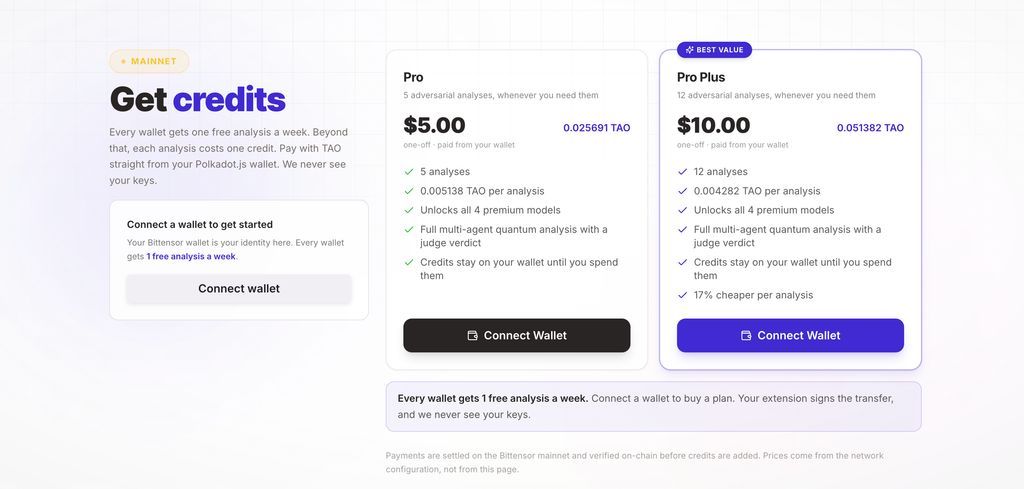
Developers can access the service through the TAOstatus website, with validated agents available through the Agent Marketplace.
What Makes Its Approach Different?
The main distinction is that TAOstatus evaluates agents on vulnerabilities they can prove, not simply issues they flag.
Traditional static scanners can return large numbers of possible vulnerabilities, leaving developers to investigate which ones are genuine.
TAOstatus uses proof-of-exploit testing to assess whether an agent can demonstrate a working attack against a vulnerable target.
Agents are tested against purpose-built targets that use randomised ground truth, so memorised results fail. Validators therefore have a clear performance signal before agents reach the customer marketplace. All assessment runs inside an isolated sandbox that protects the submitted code.
What Powers TAOstatus on SN104?
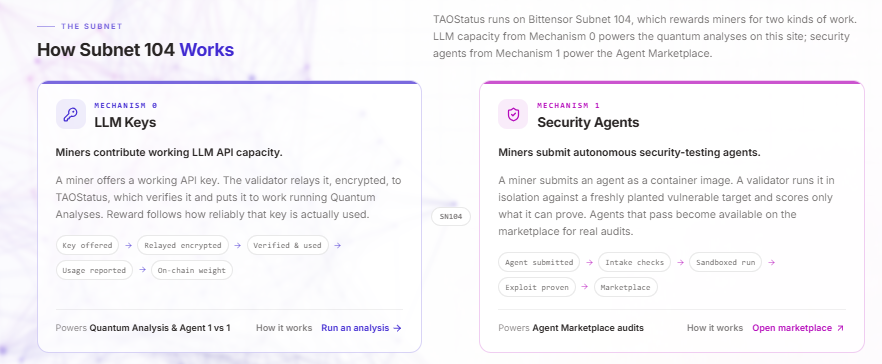
The auditing service is built on Bittensor Subnet 104, which describes itself as a Predictive Intelligence Layer. TAOstatus operates two independent mechanisms that share the same miners, validators and wallets.
1) Mechanism 0 (LLM API capacity): Miners contribute working LLM API keys, encrypted end-to-end. These provide capacity for quantum analyses and other agent workloads. Rewards account for actual usage, reliability and latency.
2) Mechanism 1 (AI security agents): Miners submit autonomous security-testing agents as container images. Validators assess them against isolated vulnerable targets and score their ability to prove exploits. Agents that pass can enter the marketplace and take on customer audits.
The setup allows SN104 to support both LLM capacity and security testing while keeping their evaluation processes separate.
How It Fits Into Bittensor’s Security Landscape
TAOstatus is not the only Bittensor subnet developing AI-powered security tools. Bitsec (SN60) has also entered the space with Sentios, a product focused on continuous AI-powered security scanning.
The difference is in the service each provides. Sentios focuses on ongoing security reviews, while TAOstatus offers repository audits built around verifying whether vulnerabilities can be exploited. Both approaches put competing AI security agents to work on practical software security problems.
With this new workflow, TAOstatus gives developers a direct way to put competing AI security agents to work on their code. The agents are judged on what they can prove, and developers receive findings they can investigate and fix.
That’s a practical use of Bittensor’s competitive model, with a clear service on the other end.
≫ For more on Bitsec’s approach, see our coverage of Sentios’ Proof of Spend badges below:
Enjoyed this article? Join our newsletter
Get the latest TAO & Bittensor news straight to your inbox.
We respect your privacy. Unsubscribe anytime.
Enjoyed this article?
Join our newsletter
Get the latest TAO & Bittensor news straight to your inbox — every morning before markets open.



No comments yet — be the first.