


If the owner key of Subnet 3 can be drained in eight minutes, so can yours. The fix is a three-layer setup most holders can put in place this week.
Eight minutes on SN3
Around 16:18 on November 11, the owner coldkey of Subnet 3 moved 101,141 alpha to a brand-new wallet. Eight minutes later that alpha was sold for roughly 2,068 TAO, and the proceeds were scattered across fresh wallets, part of it through ChangeNOW.
Const confirmed the key was compromised. He said the multisig, proxy, and vault setup weren’t in place. His advice to everyone else was to set those up now.
The fallout did not stay with one wallet. The sudden alpha sell-off triggered the biggest liquidation event yet on Mentat, a Bittensor lending protocol.
The biggest concern is not who got hit. Many holders, validators and subnet owners still keep everything on one unprotected key stored on an online machine.
Why this is a business problem, not just a security one
On Bittensor, a signed transaction is final. There is no bank to call and no chargeback. Whatever a single key controls can be gone before you notice.
The stakes are highest for subnet owners, validators and even stakers. An owner key controls a subnet’s ownership and emissions and a validator’s coldkey carries its delegators’ trust. As Mentat showed, the damage also affects people who just stake in the alpha tokens.
Tensia Foundation’s on-chain review found the SN3 key had been active since March 2026 and used across btcli, the Python SDK and other tools. It was a working “hot” key doing a vault key’s job, with no multisig or proxy on it at any point. Two days earlier, on November 9, the same key had sent roughly 460 TAO worth of alpha to an address no one controls, through a misconfigured transaction.
Protect the Funds First
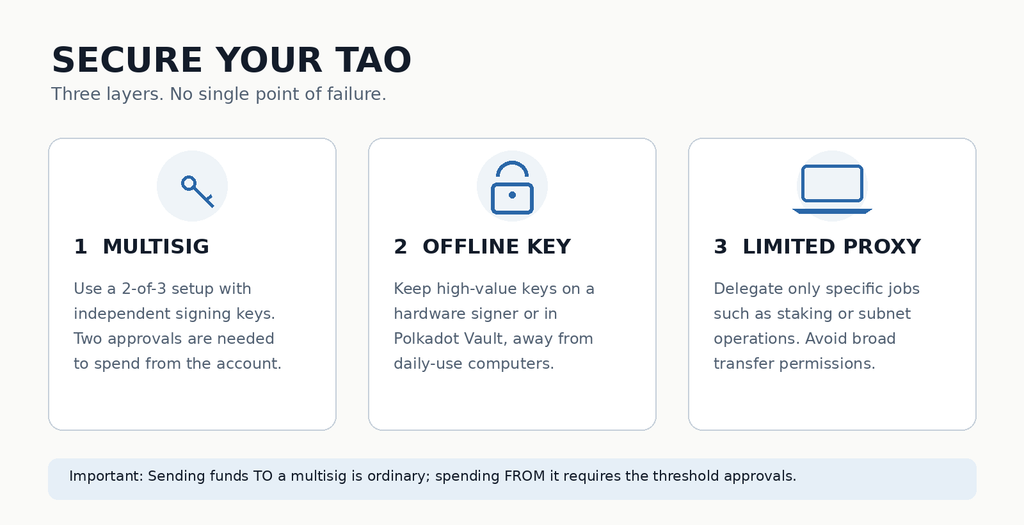
Put valuable holdings behind a multisig account. A 2-of-3 setup requires approval from any two of three independent keys before funds can leave. Keep the signers on different devices or with different trusted custodians. Three keys stored on the same laptop defeat much of the protection.
Bittensor supports this natively. Our earlier multisig explainer covers the basics, while the official walkthrough includes setup commands and a testnet rehearsal.
Limit What a Working Key Can Do
A proxy lets a separate key handle routine tasks while the main coldkey stays protected. A Staking proxy can manage staking without transferring free TAO. A subnet owner can use an Owner proxy for selected operational changes without giving away full ownership control.
Choose only the permissions a job needs. Avoid unrestricted Any proxies, which can expose the account to the same risks as the primary key. The official proxy guide explains the available roles and how to revoke them.
Take the Primary Key Offline
Keep sensitive signing material off everyday laptops, bots and servers. A hardware signer or Polkadot Vault can approve transactions without exposing the recovery phrase to an internet-connected machine.
Back up each recovery phrase offline, keep signers physically separate and test recovery before moving significant funds. For subnet teams managing shared assets, this should be part of normal operations
Quantum-resistant keys are the next layer
Bittensor’s quantum-resistant wallets are now in code. That protects against a different, longer-term threat, a future computer strong enough to break today’s signatures.
The wallet code supports three post-quantum schemes, ML-DSA-65 (standardised by NIST), Falcon-512 and Falcon-1024, for both coldkeys and hotkeys. They cover transfers, staking, moving stake, setting weights and registration.
The new keys work with multisig and proxies, and every valid approval path must include at least one quantum-resistant signature. Holders can also turn on automatic key rotation, which moves the account to a fresh signing key after each transaction while keeping the same address and recovery phrase. Rotation needs a one-time, permanent lock of 0.2 TAO.
Switching is optional. Existing wallets keep working, and anyone who wants the protection creates a new account in compatible wallet software, then moves funds with a transfer or coldkey swap.
Quantum resistance does not fix bad key handling, though. The SN3 drain was an operational failure, not a broken signature. Get the three layers right first, then add quantum-resistant keys when you next move funds to a new cold account.
The bottom line
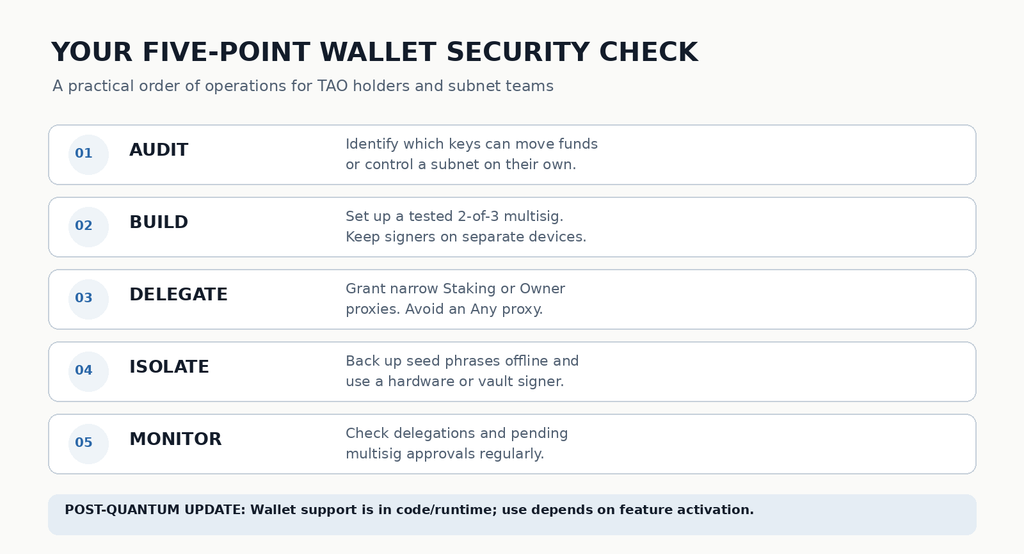
Self-custody gives you full control and full consequence. A cold key, a scoped proxy and a multisig take an afternoon to set up. Skipping them can cost everything a key controls, in minutes. If you hold meaningful TAO, run a validator or own a subnet, treat this week as your deadline.
Resources
1) Securing a wallet: Ledgers, multisig, proxies (Taostats)
2) Proxy accounts guide and Multisig guide (bittensor.com)
3) Coldkey and hotkey workstation security (Learn Bittensor)
4) Stop Putting All Your TAO in One Basket (The TAO Daily)
5) Bittensor’s Quantum-Resistant Wallets Are Now in Code (The TAO Daily)
Enjoyed this article? Join our newsletter
Get the latest TAO & Bittensor news straight to your inbox.
We respect your privacy. Unsubscribe anytime.
Enjoyed this article?
Join our newsletter
Get the latest TAO & Bittensor news straight to your inbox — every morning before markets open.


No comments yet — be the first.