


Gamma Tokens are officially live on Bittensor, introducing a native payment system that allows users and AI agents to pay for subnet services through a Bittensor wallet.
The network-wide feature was activated on November 9, 2026, allowing individual subnets to begin accepting Gamma as payment for their products.
The launch brings to life an idea first introduced by Bittensor co-founder Const at Exploit Summit on September 28. As The TAO Daily reported at the time, Gamma was designed to connect Bittensor’s growing range of AI services, making it possible for subnets to become customers of one another.
With the upgrade now live, Bittensor has the foundation for a shared payment system across its AI economy. Subnets must individually enable Gamma and integrate it into their services before customers can begin using it.
What Are Gamma Tokens?
Gamma is a prepaid credit that customers can use to access products and services offered by Bittensor subnets. Each Gamma represents $1 worth of service credit, making it possible to pay for AI products without worrying about fluctuations in TAO or alpha prices.
For example, a user could purchase 100 Gamma worth $100 to access an inference service. That credit would retain its $100 value even if the price of TAO or the subnet’s alpha changes. The service provider still determines how much it charges for each request or service.
Every subnet has its own Gamma credits, which can only be spent on that particular subnet. Credits purchased for a compute service cannot be used to pay for storage on another subnet. Gamma is also not a tradable cryptocurrency. It cannot be transferred to another wallet or redeemed for TAO or alpha.
The problem Gamma solves
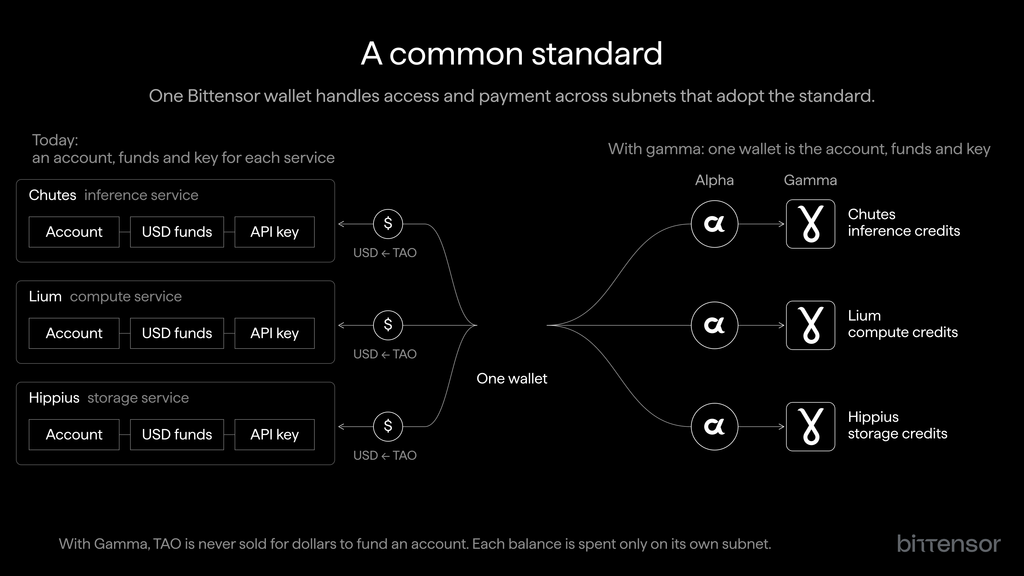
Today, using a subnet’s service usually means:
1) Creating an account
2) Adding funds
3) Getting an API key
Then doing it all again for the next subnet. For an app that needs inference from one subnet, compute from another and storage from a third, that’s three sign-ups, three balances, and three keys.
Gamma replaces all of that with your Bittensor wallet.
How it works, step by step
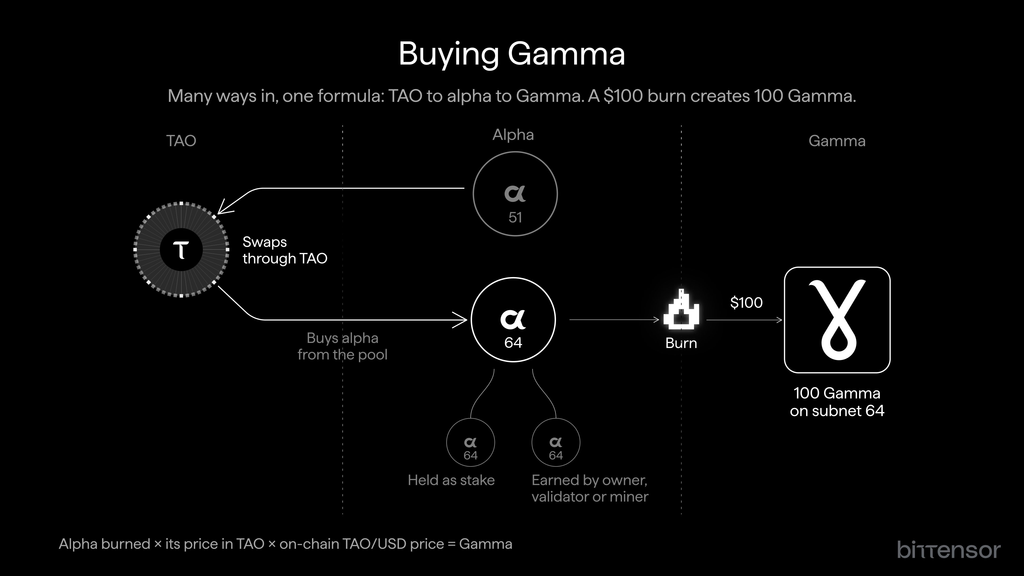
1. You create Gamma for a specific subnet. There are two ways:
– Pay with TAO. The protocol buys the subnet’s alpha and burns it, then gives you Gamma. All in one transaction.
– Pay with alpha. If you already hold that subnet’s alpha, the protocol burns it directly and gives you Gamma.
2. Gamma is priced in dollars. The burned alpha is valued in TAO, then converted to dollars using an on-chain TAO/USD price feed. 1 Gamma = $1. Burn $100 worth of alpha and you get 100 Gamma.
3. Your credits hold their value. Once created, your Gamma stays worth the same in dollars, even if TAO or alpha prices swing. Service providers still set their own prices.
4. You spend it with a signed request. You (or your AI agent) sign a request with a hotkey from your wallet. The hotkey effectively acts as your API key. The subnet owner, or another authorised account, deducts the credits before delivering the service.
5. You stay in control. You can set daily spending limits, pause deductions, keep separate balances for different apps or agents, and top up without changing hotkeys.
What This Could Look Like for AI Users
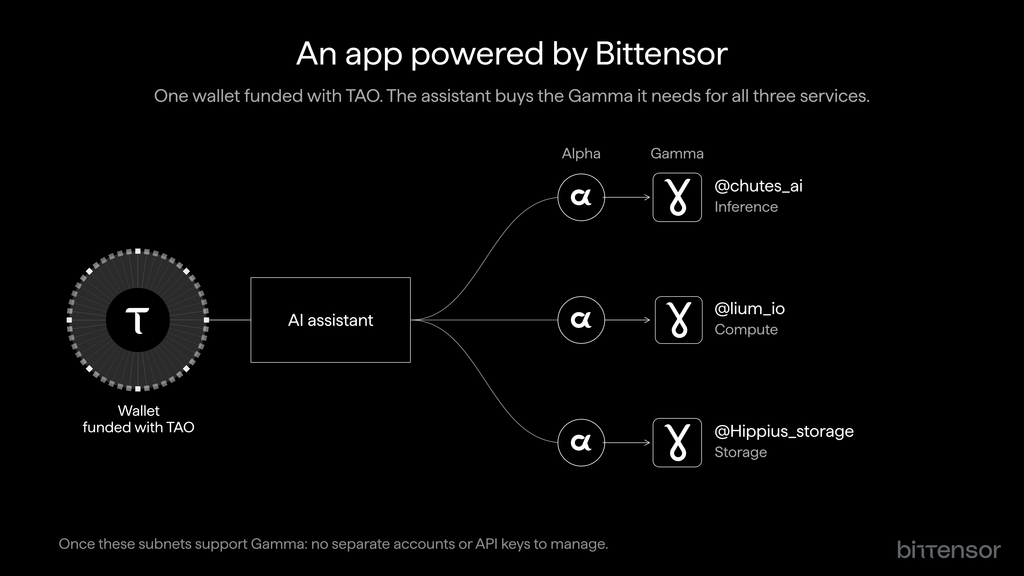
Consider an AI assistant that needs inference from Chutes (SN64), computing power from Lium (SN51) and storage from Hippius (SN75).
Today, accessing these products can require separate accounts, funding arrangements and API keys. An application combining all three must manage those connections individually.
With Gamma, once these providers adopt the standard, a user could connect a Bittensor wallet funded with TAO and let the assistant purchase the credits needed for each service. The application could handle the payments and requests while the user continues interacting with a single interface.
The same model could extend to autonomous AI agents that need to purchase computing power, process information, store files or use other services to complete tasks. Subnet operators and validators can also publish service information on-chain, making it easier for developers and agents to discover what is available.
Why Gamma Matters for Bittensor
One of Gamma’s most important features is its direct connection between demand for a subnet’s services and the subnet’s alpha token.
Every time Gamma is created, alpha is permanently removed from circulation. Customers paying with TAO also generate a purchase of alpha from the subnet’s liquidity pool before the burn takes place. This means demand for a subnet’s products can translate into demand for its alpha and a reduction in circulating supply.
The credits are subsequently destroyed when spent. They do not transfer TAO or alpha directly to the service provider. Instead, the economic value of the initial alpha burn accrues to the subnet’s alpha holders.
This creates a mechanism through which real demand for AI products can contribute to a subnet’s token economy. As usage grows, the amount of alpha burned through Gamma purchases could grow with it.
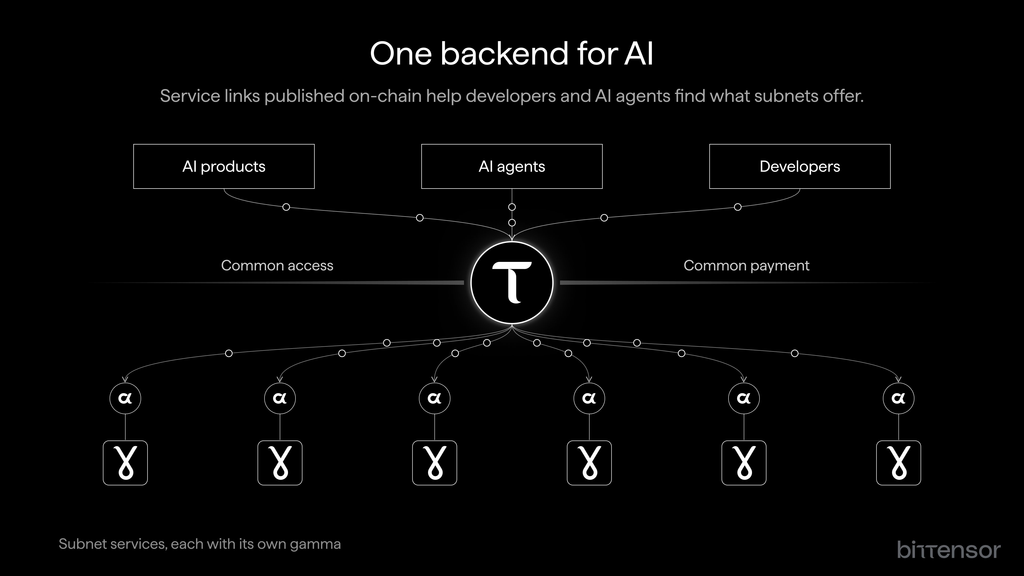
Gamma also opens the door to deeper commercial relationships between subnets. An AI project could rely on another subnet for infrastructure, purchase its services through Gamma and incorporate those services into a finished product. Subnets could increasingly become suppliers and customers within the same network.
A further upgrade is being developed to allow subnet owners to allocate portions of their emissions toward purchasing Gamma credits from other subnets. That functionality is planned for a subsequent runtime release and is not part of this initial live rollout.
Which Subnets Have Enabled Gamma?
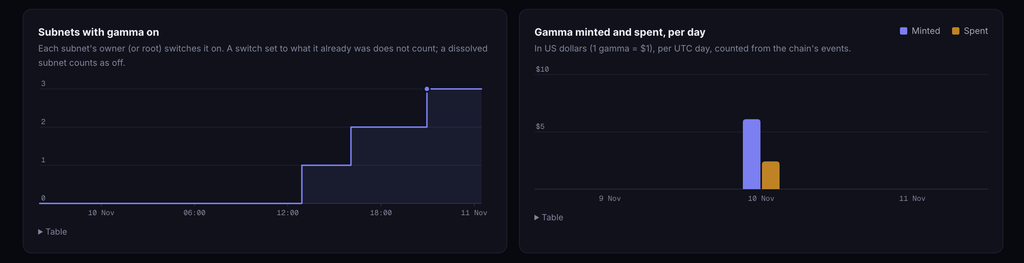
Adoption has begun. According to SubnetRadar’s on-chain Gamma tracker, Attune (SN58), Engy (SN53) and Terza Inference (SN103) were the first three subnets to enable Gamma on November 10.
The tracker also recorded the first Gamma mint and spend on Terza Inference. At its latest indexed reading on November 10, approximately $0.42 in Gamma had been created and spent, with no outstanding credits remaining. These are the earliest transactions, with broader adoption still ahead.
Readers can also follow the rollout through Taostats’ Gamma dashboard, which provides visibility into enabled subnets, Gamma creation and spending activity.
What Comes Next?
Gamma’s launch establishes the payment infrastructure, but its impact will depend on how widely subnets adopt it and how easily developers integrate it into their products.
The immediate opportunity is simpler access to Bittensor’s services. Over time, the opportunity is an economy where AI agents can purchase resources, applications can combine products from multiple subnets, and customer demand can feed directly into subnet token economics.
Bittensor has spent years building a network capable of producing AI services. Gamma introduces a common way for customers, developers and autonomous agents to pay for and use them.
The next chapter will be determined by how many of those services begin doing business through it.
Read more
- Gamma proposal
- Implementation (PR #3283)
- Release PR #3304
- Live Gamma stats on taostats
- Our original Exploit Summit coverage
Enjoyed this article? Join our newsletter
Get the latest TAO & Bittensor news straight to your inbox.
We respect your privacy. Unsubscribe anytime.
Enjoyed this article?
Join our newsletter
Get the latest TAO & Bittensor news straight to your inbox — every morning before markets open.
No comments yet — be the first.