


Imagine two companies offering access to the same AI model. One charges $3 to generate one million tokens, while the other charges just $0.32.
That’s almost 90% cheaper for the same amount of AI-generated text.
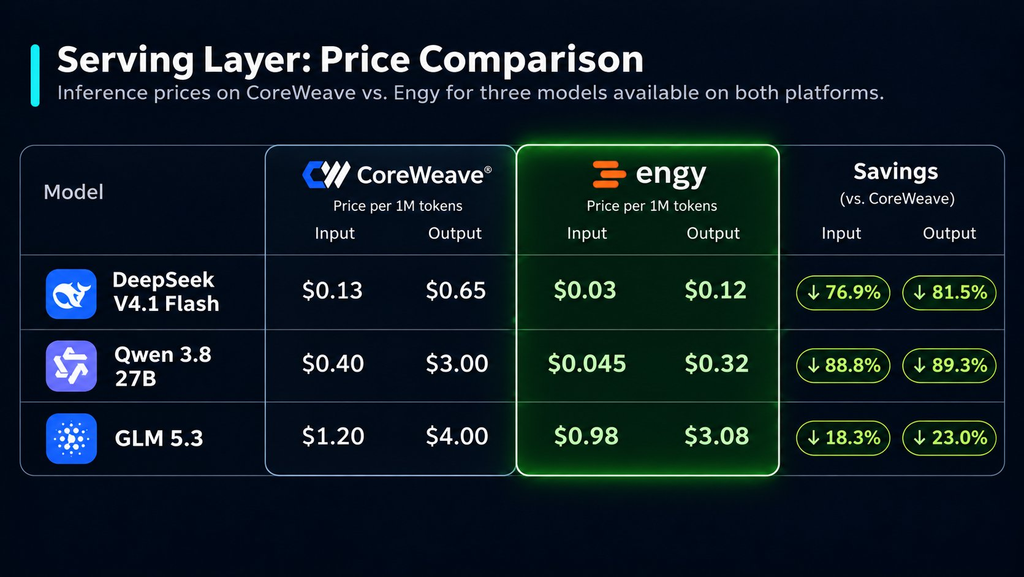
This isn’t hypothetical. CoreWeave lists Qwen3.8 27B inference at $3 per million output tokens, while Engy (SN53), a Bittensor subnet, offers the model at $0.32. For input tokens, CoreWeave charges $0.40 per million compared with Engy’s $0.045.
The difference extends to other models. For DeepSeek V4 Flash, CoreWeave lists output tokens at $0.28 per million, while Engy charges $0.09.
So how can a decentralized network offer the same AI models at significantly lower prices?
The Beauty of Bittensor’s Competition
Traditional AI infrastructure companies such as CoreWeave purchase computing hardware, employ engineers to optimize their systems, pay for electricity, and sell AI inference to customers.
How cheaply they can serve those customers depends on their engineering capabilities, operating costs, and the margins they need to maintain.
Bittensor introduces a different approach.
On Engy (Bittensor subnet 53), for instance, independent miners contribute computing resources and compete to deliver inference efficiently. They can bring different hardware, engineering techniques, electricity costs, and financial expectations into the same network.
Think about the possibilities.
Someone operating GPUs in a country with cheap electricity might be able to provide inference at a lower cost. Another miner might develop optimizations that allow the same GPUs to process five times as many tokens. Someone else might accept smaller profit margins to remain competitive.
Bittensor allows all these people to compete, with the network benefiting from whichever approaches deliver the best results.
And here’s the interesting part. A miner who has the best setup today could lose that advantage tomorrow when someone discovers a better approach.
That creates continuous pressure to improve efficiency. When those improvements translate into lower customer prices, a subnet can compete with much larger companies without owning all the infrastructure itself.
Engy’s pricing shows what this model can achieve in practice.
Why This Is Bigger Than AI Inference
Now extend that thinking beyond Engy.
Bittensor has subnets working on AI training, computing, storage, forecasting, and other digital services. Each can design incentives that encourage independent miners to compete on the qualities its customers value.
A traditional company must build or acquire much of its competitive advantage internally. A subnet can create an open competition for people around the world to contribute theirs.
Of course, the competition must produce a service customers actually want. But when it works, the result can be powerful: lower costs, better performance, and improvements that aren’t limited to one company’s engineering team.
This is why Bittensor’s subnet model is so interesting.
We’re used to thinking that the company with the most money, the most GPUs, and the best engineers should win.
Bittensor is testing a different idea: What if the winning company is the one that gets the world’s best operators to compete for it?
Engy is already providing a compelling example of what that could look like.
➛ More about Engy (SN53):
Enjoyed this article? Join our newsletter
Get the latest TAO & Bittensor news straight to your inbox.
We respect your privacy. Unsubscribe anytime.
Enjoyed this article?
Join our newsletter
Get the latest TAO & Bittensor news straight to your inbox — every morning before markets open.

No comments yet — be the first.