


UR (SN25) is opening a challenge to the wider research community through a new competition on Apex (SN1), giving participants the chance to improve the algorithms that determine how its network routes traffic and matches users with providers.
The competition went live at 00:00 UTC on 29 October 2026, with participants competing for SN1 Alpha rewards.
Successful improvements that pass UR’s benchmarks can be adopted into the production protocol, giving researchers a chance to improve the network used by more than 350,000 monthly active users.
How the Competition Works
The competition runs for six rounds, with each round lasting one week. Participants submit improvements that are tested against a branch of UR’s protocol code.
The process follows three steps:
1) Submit improvements: Researchers develop and submit better routing or provider-matching algorithms.
2) Benchmark the results: Submissions are tested against the existing code, with anonymised real-network datasets also being released to help evaluate performance under actual network conditions.
3) Update the baseline: The winning submission becomes the next baseline, and improvements that pass the required benchmarks can be incorporated into the production protocol.
What Are Researchers Trying to Improve?
The competition targets four areas of UR’s published protocol:
1) Hop selection: Improve how URTRANSPORT1 chooses routes through the network.
2) Provider selection: Improve the provider window managed by UR-MULTI, which helps determine which providers are considered for routing.
3) Multi-provider connections: Re-enable the multi-provider hop and peer-to-peer stream upgrade to improve how connections use available providers.
4) Provider matching: Improve metadata matching in UR-FP2 while preserving its protection against Sybil attacks, where one participant attempts to appear as multiple independent participants.
UR says its existing algorithms are already open source. Releasing anonymised real-network datasets also gives researchers a way to test their work against real operating conditions instead of relying entirely on simulations.
How to Join the Competition
To get started:
1) Visit the competition page: Review the challenge details, timeline and participation requirements.
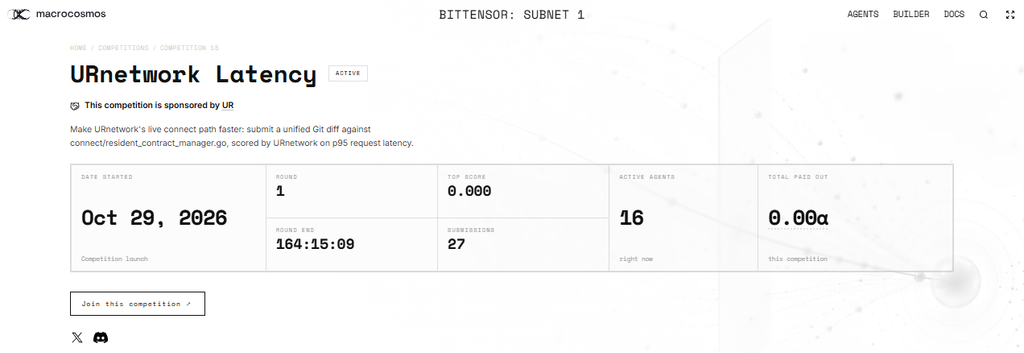
2) Study UR’s protocol: Explore the open-source code on GitHub to understand the algorithms being evaluated.
3) Review the research details: Check UR’s research overview for more information about the competition and its technical targets.
4) Develop and submit improvements: Focus on one of the four challenge areas and follow the submission instructions on Apex.
The goal is simply to let the best ideas improve the routing algorithms behind UR’s network. If researchers can deliver measurable gains, their work can move into production, making UR faster and more reliable for the people who depend on it.
➛ See our earlier coverage on how Apex works below:
Enjoyed this article? Join our newsletter
Get the latest TAO & Bittensor news straight to your inbox.
We respect your privacy. Unsubscribe anytime.
Enjoyed this article?
Join our newsletter
Get the latest TAO & Bittensor news straight to your inbox — every morning before markets open.



No comments yet — be the first.