

If you’re looking at Bittensor subnets and feeling overwhelmed by the mechanics, you’re not alone. The system is elegant but layered. The good news: once you understand five core fundamentals, the entire subnet economy starts making sense — and you’ll know exactly where to look when evaluating whether a subnet is worth your attention.
Let’s break them down.
1. Sum of Subnets (SoS) — The Market’s Mood Ring
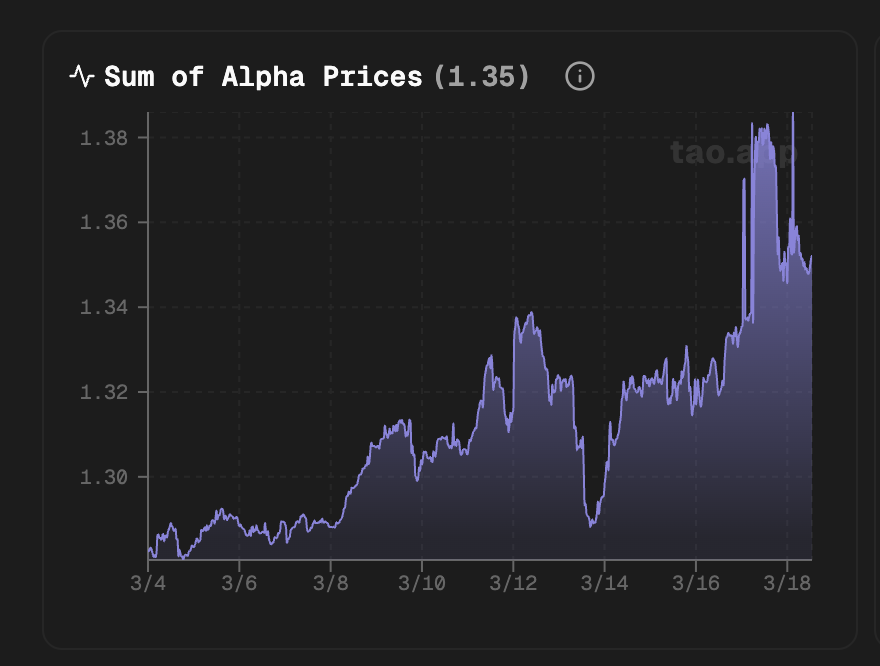
SoS = FDV of all subnets / FDV of TAO
Think of this as the macro sentiment indicator for the entire subnet ecosystem. It tells you whether the market collectively values subnets above, below, or in line with TAO itself.
- SoS < 1 — Subnets are undervalued. The combined fully diluted value of every subnet is less than TAO’s. This could signal early-stage opportunity — or a lack of confidence in subnets broadly.
- SoS ≈ 1 — Fair value territory. The subnet economy is priced in line with the base layer.
- SoS > 1 — Subnets are trading at a premium to TAO. This often reflects high demand, speculation, or genuine belief that subnet value will outpace the base asset.
SoS won’t tell you which subnet to buy. But it will tell you whether the market is hungry for subnets or still sitting on the sidelines. Use it as your top-level compass.
CURRENT SoS: 1.35
2. % Emissions — Who’s Getting Fed
Bittensor distributes roughly 3,600 TAO per day as incentives across the network. Each subnet earns a slice of that pie, and this percentage matters more than most people realize.
Why? Because the TAO that a subnet earns gets injected directly into its TAO/Alpha liquidity pool. That LP is the backbone of the subnet’s trading pair. More TAO flowing in means deeper liquidity, tighter spreads, and a healthier market for that subnet’s token.
Here’s where it gets important:
- High % emissions = a fat stream of TAO pouring into the LP every day. The pool stays deep, trades have low slippage, and the subnet token has strong structural support.
- 0% emissions = zero TAO entering the LP. Alpha tokens still get emitted to the three stakeholder groups (more on that below), but the pool itself is starving. It gets thinner with every passing day.
NOTE: A subnet with 0% emissions isn’t dead — alpha tokens are still being distributed. But without fresh TAO in the pool, any significant sell pressure from stakeholders can cause outsized price impact.
3. dTAO and TAO Flow — The Engine Behind Emissions
So what determines a subnet’s emission percentage? That’s where the dTAO mechanism comes in.
Under dTAO, emission allocation is driven by Net TAO Flow:
Net TAO Flow = TAO In – TAO Out (Smoothed using an Exponential Moving Average with a 30-day half-life)
Putting this simply, the network watches how much TAO is flowing into a subnet versus how much is leaving. If more capital is entering than exiting, that subnet’s emission share increases. If capital is fleeing, emissions shrink.
This creates a powerful flywheel. When a subnet attracts TAO inflow, it earns higher emissions, which deepens its LP, which makes the token more attractive to hold, which draws more inflow. The reverse is equally true, outflows trigger lower emissions, thinner liquidity, and more selling pressure.
The EMA smoothing with a 30-day half-life prevents sudden spikes from gaming the system. It rewards sustained conviction, not one-day pumps.
4. Alpha Token Emission Split — The 18/41/41 Rule
Every subnet emits its own alpha tokens daily. These tokens are distributed to three groups that keep the subnet running:
| Share | Stakeholder | What They Do |
|---|---|---|
| 18% | Subnet Owners | The team that builds, maintains, and operates the subnet |
| 41% | Miners | The talent — contributors who perform the actual computational work |
| 41% | Validators | Stakers and validators who evaluate and verify miner output |
This split is consistent across all subnets. It means that no matter which subnet you’re looking at, the majority of token emissions (82%) go to the people doing the work and securing the network, while the team takes a smaller cut.
For investors, the key insight is that miners and validators are constantly receiving tokens. Whether they hold or sell directly affects the subnet’s token price — and how much that sell pressure impacts the market depends entirely on the depth of the TAO/Alpha LP (which loops back to emissions and flow).
5. Root Prop — The Network Security Tax
Not all of the 41% validator allocation stays within the subnet. A portion gets taxed and redirected to Subnet 0 (root) validators, the group responsible for securing the entire Bittensor network.
Think of it as a security levy. Subnet 0 is the root network. Without it, the whole ecosystem’s integrity falls apart. The root prop mechanism ensures that validators protecting the base layer are always compensated, funded by a cut from every subnet’s validator emissions.
A higher root prop percentage means a bigger tax on subnet earnings. It’s a trade-off: more security for the network, but less yield flowing to individual subnet validators and stakers.
Understanding Both Sides of Emissions
This is where many newcomers get tripped up. There are two separate emission flows happening simultaneously:
- TAO emissions to subnets — TAO flowing into the TAO/Alpha LP, determined by net flow and the dTAO system. This is what keeps the liquidity pool healthy.
- Alpha token emissions to stakeholders — the 18/41/41 distribution to owners, miners, and validators. This happens regardless of whether the subnet earns TAO emissions or not.
Here’s the catch: even if a subnet earns 0% TAO emission, alpha tokens are still being minted and handed to stakeholders. But there’s no new TAO entering the pool to absorb sell pressure. So when miners or validators cash out, they’re selling into an increasingly shallow pool, and the price impact compounds.
Subnet Investing Strategy
With all five fundamentals in hand, here’s the practical application, and it starts with one metric.
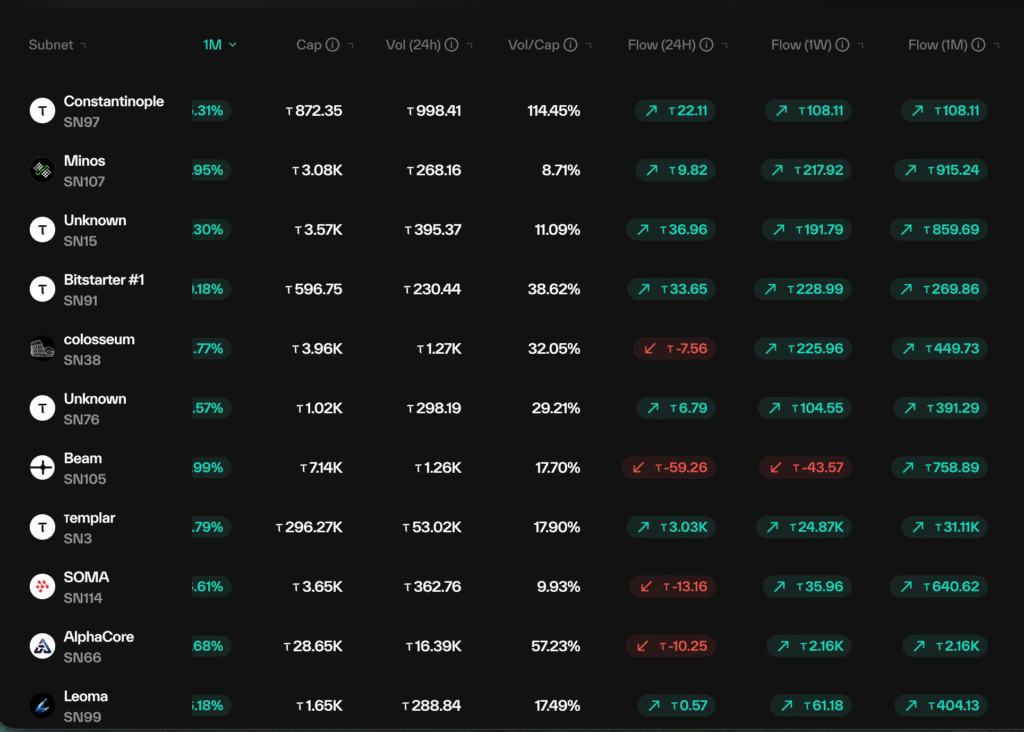
Look at “Flow” on Taostats.
TAO Flow is the single most revealing signal for subnet health and momentum. Bigger flow means higher alpha token accumulation, greater TAO emissions, and deeper liquidity. It’s the heartbeat of a subnet.
The playbook:
- Screen for subnets with increasing flow. Rising flow means capital is entering. Something is attracting attention.
- Dig into the “why.” Is the subnet shipping new features? Did it onboard a major miner? Is a narrative forming? Flow without substance is just speculation, and flow backed by real progress is where conviction builds.
- Invest in subnets with solid fundamentals. Not every rising-flow subnet is a good bet. Pair the flow data with an honest assessment of the team, the use case, miner quality, and validator engagement.
If you identify a trend early enough, the upside compounds across three vectors:
- Subnet token price appreciation — as demand and liquidity grow.
- High emissions yield — from holding tokens that earn a share of increasing TAO emissions.
- TAO price action — as subnet demand drives broader demand for the base asset, $TAO.
Where to track these metrics:
- Taostats — Flow metrics, emission breakdowns, subnet-level analytics. Website here.
- Taoapp — Additional tracking and subnet comparison tools. Website here.
Credit to 0xJeff for the insights.
Enjoyed this article? Join our newsletter
Get the latest Bittensor & TAO ecosystem news straight to your inbox.
We respect your privacy. Unsubscribe anytime.


Be the first to comment